USAID. BUR. FOR PROGRAM AND POLICY COORDINATION. CENTER FOR DEVELOPMENT INFORMATION AND EVALUATION (CDIE)
Operational issues in developing AID policy reform programs
Program assistance for the support of macroeconomic and sectoral policy reform has become a major element in A.I.D.'s strategy for fostering broad-based and sustainable economic growth in developing countries.
Vondal, Patricia · 1989
Sign in to readA free account is required to download.
Abstract
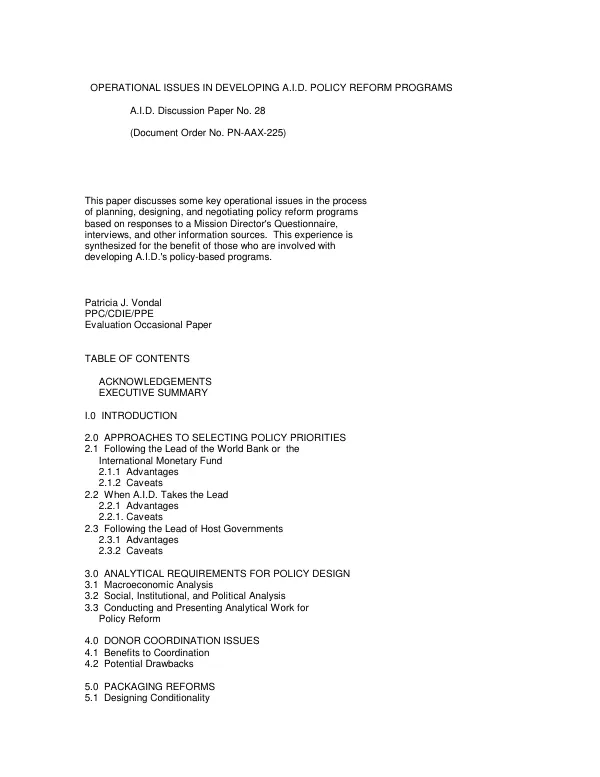
This paper identifies and discusses some of the major operational issues involved in the process of planning, designing, and negotiating policy reform programs. It is primarily based on lessons learned from A.I.D. experience in developing sector-specific and macroeconomic policy reform programs in Central America, Asia, the Near East, and Africa since 1983. The topics covered include: approaches to selecting policy objectives; analytical requirements for designing programs; donor coordination; design of conditionality; use of A.I.D. resources in packaging reforms; sources of A.I.D. influence; and negotiation strategies and styles. The study also suggests approaches to developing and promoting reform programs based on past successful experiences. The primary conclusion is that the manner in which A.I.D. develops and negotiates policy reform programs has major implications for the degree of support, the implementation, and the sustainability of the reform program, as well as for the tenor of bilateral relations between the U.S. and host country government. Therefore, A.I.D. efforts which emphasize collaboration, consensus-building, flexibility, cultural sensitivity, and recognition of local political and economic realities hold the most promise. (Author abstract, modified)
Connected topics