USAID DEC
Optimizing Mycobacterial Culture in Smear-Negative, Human Immunodeficiency Virus-Infected Tuberculosis Cases
Sign inOPEN UNIVERSITY
Optimizing Mycobacterial Culture in Smear-Negative, Human Immunodeficiency Virus-Infected Tuberculosis Cases
Tuberculosis (TB) remains a significant public health problem, particularly in South Africa, where it is a leading cause of death.
2015 · 9 pages
Sign in to readA free account is required to download.
Abstract
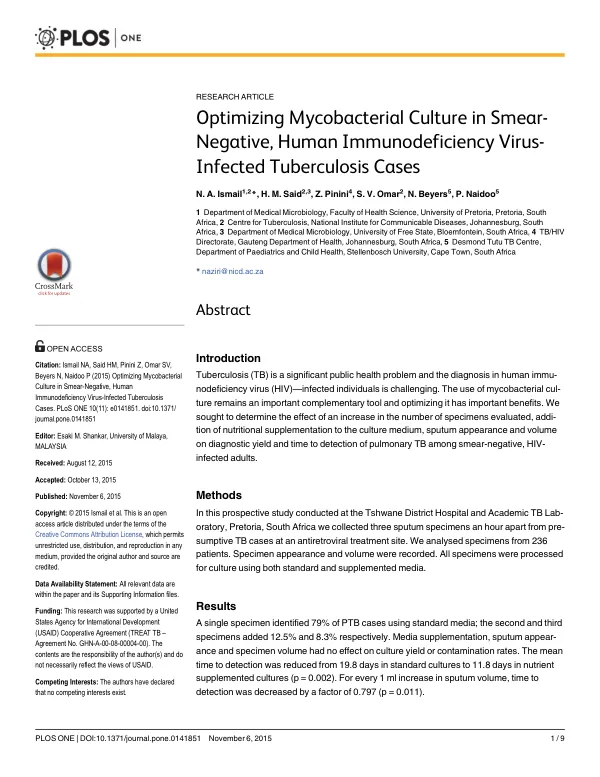
Human immunodeficiency virus (HIV) infection is a major contributing factor, increasing the risk of developing TB and making diagnosis more challenging. Microbiological testing is essential in diagnosing TB in HIV-infected individuals, as chest radiography and symptom screening have poor specificity. Direct smear microscopy is widely used as the primary test for TB, but its sensitivity in HIV-infected individuals is low, ranging from 31% to 69%. This implies that half of all TB cases may be missed when using microscopy alone for making the diagnosis of TB in HIV-infected individuals. The introduction of the Xpert MTB/RIF (Xpert) assay has improved the sensitivity of TB diagnosis in HIV-infected individuals, but it still misses 1 in 5 culture-positive cases. Mycobacterial culture, although more labor-intensive, is more sensitive than both smear microscopy and Xpert and has been recommended for use in the diagnosis of TB in HIV-infected individuals, including for smear- and Xpert-negative cases. The factors influencing the diagnostic yield of smear microscopy have been reviewed, but limited information is available on factors influencing the diagnostic yield of mycobacterial culture, especially among HIV-infected individuals. A prospective cohort study was conducted at the Tshwane District Hospital in Pretoria, South Africa, to determine the effect of an increase in the number of specimens evaluated, the addition of nutritional supplementation to the culture medium, sputum quality, and volume on the diagnostic yield of culture and on time to detection of TB among smear-negative, HIV-infected cases. The study recruited 236 presumptive pulmonary TB cases from the Comprehensive HIV and AIDS Care Centre at Tshwane District Hospital. The participants were HIV-infected adults above 18 years of age, not on TB treatment, and with two smear-negative results in the last four weeks. The study found that a single specimen identified 79% of pulmonary TB cases using standard media, while the second and third specimens added 12.5% and 8.3%, respectively. Media supplementation, sputum appearance, and specimen volume had no effect on culture yield or contamination rates. However, the mean time to detection was reduced from 19.8 days in standard cultures to 11.8 days in nutrient-supplemented cultures. For every 1 ml increase in sputum volume, time to detection was decreased by a factor of 0.797. The study's findings suggest that the use of an inexpensive culture supplement can substantially reduce time to detection and contribute to reducing treatment delay among HIV-infected cases. The results of this study have important implications for the diagnosis and treatment of TB in HIV-infected individuals, particularly in resource-limited settings where access to diagnostic tools and healthcare services is limited.
Related documents