USAID DEC
Optimizing viral load testing access for the last mile: Geospatial cost model for point of care instrument placement
Sign inRIGHT TO CARE
Optimizing viral load testing access for the last mile: Geospatial cost model for point of care instrument placement
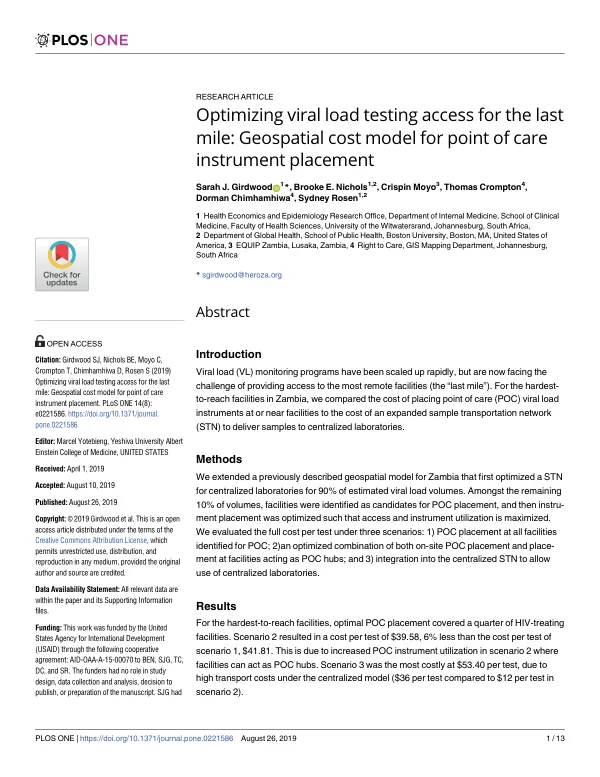
The study aimed to optimize viral load testing access for the hardest-to-reach facilities in Zambia.
2019 · 13 pages
Sign in to readA free account is required to download.
Abstract
A geospatial cost model was developed to compare the cost of placing point of care (POC) viral load instruments at or near facilities to the cost of an expanded sample transportation network (STN) to deliver samples to centralized laboratories. The model identified 800,000 patients on antiretroviral therapy (ART) in Zambia in 2017, with nearly 1.2 million expected by 2020. The study found that the national STN, which was previously optimized, could increase access to viral load testing from 10% in 2016 to 91% in 2020, covering 1,475 facilities with an estimated total viral load volume of approximately 1.5 million samples per year. However, nearly one in ten patients and nearly half of ART facilities remained without reliable access. The study compared three scenarios: POC placement at all identified facilities, a combination of on-site placement and POC hubs, and centralized STN. The results showed that POC placement at all identified facilities would cover 9% of HIV-treating facilities, with a cost per test of $41.58. The combination of on-site placement and POC hubs reduced the cost per test by 6% to $39.58, while the centralized STN was the most costly at $53.40 per test. The study concluded that POC viral load instrument placement can reduce costs by eliminating transport costs and improve turn times for result delivery. However, the performance of POC technologies in low-throughput remote settings is not well understood, and further research is needed to explore their cost-effectiveness in these settings. The study's findings have implications for the implementation of viral load testing programs in low- and middle-income countries, particularly in rural areas where access to healthcare services is limited. The study's results suggest that POC viral load instrument placement can be a cost-effective solution for improving access to viral load testing in these settings.