UNICEF
A Policy Brief: Improving WASH and Essential Hygiene Practices in Zambia
Zambia has made improvements in nutrition over the last 5 years, but the country continues to have a high proportion of undernourished children.
2021 · 8 pages
Sign in to readA free account is required to download.
Abstract
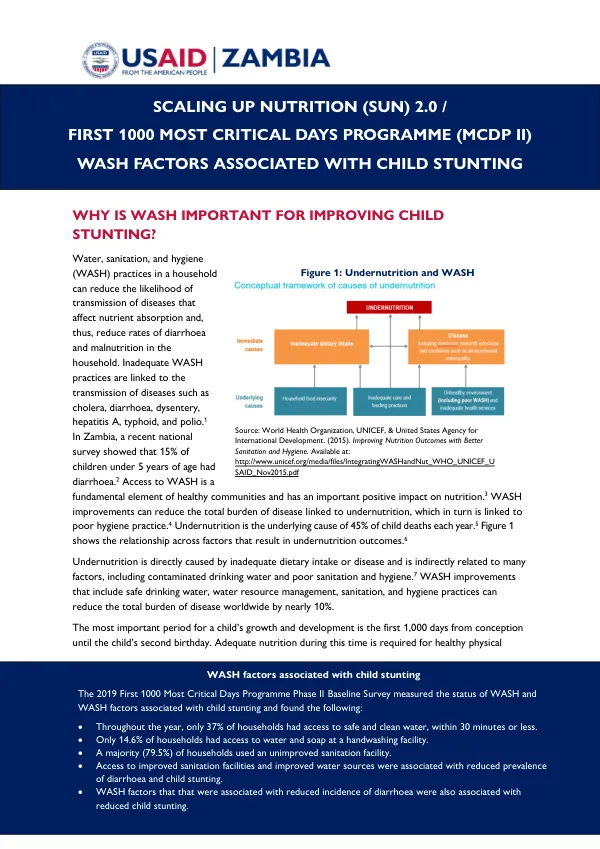
Access to water, sanitation, and hygiene (WASH) and essential hygiene practices are critical in preventing diarrhoea and childhood stunting. The Government of the Republic of Zambia has set goals for 100% of Zambians to have access to clean water and 90% of Zambians to have access to improved sanitation by 2030. However, the current reality falls far short. The 2019 Baseline Survey of the First 1000 Most Critical Days Programme Phase II (MCDP II) found that only 37.7% of households had clean drinking water, 20.5% had access to an improved sanitation facility, and less than 5.6% of households practiced essential hygiene. Studies have investigated the link between WASH, essential hygiene practices, diarrhoea, and undernutrition in Zambia. Chronic diarrhoea is linked to undernutrition due to nutrient malabsorption and the reduced ability of the human gut to serve as a barrier against disease-causing organisms. Poor access to sanitation infrastructure and clean water can increase diarrhoeal cases in a community. Furthermore, open defecation, along with children's exposure to animal or human faeces, and poor handwashing practices by children or caregivers can also result in increased rates of diarrhoea. The MCDP II strategy, developed in 2017 by the National Food and Nutrition Commission in collaboration with other nutrition stakeholders in Zambia, includes several priority WASH interventions to increase WASH practices and lower the rates of diarrhoea and stunting among young children. These WASH interventions target behaviours directly linked to essential hygiene practices, detailed by the MCDP II report. The target behaviours include caregivers washing hands at critical times, washing children's hands after going to the toilet and before eating, a clean and sanitary environment free from animal and human faeces, especially where children play, use of improved latrines, and household water treatment. The 2019 MCDP II Baseline Survey found that access to clean water and improved sanitation, and the practice of essential hygiene actions are very low in the 30 priority MCDP II districts. About 37.7% of households had access to basic drinking water, although this was much higher in urban households (60.1%) than rural households (27.2%). Only 20.5% of households had access to an improved sanitation facility, and urban households (40.3%) had greater access, compared to rural households (11.4%). The survey found that only 5.6% of households practiced essential hygiene, with 15.8% of urban households and 0.9% of rural households practicing these behaviours. In the 2 weeks leading up to the survey, 34.7% of households had children who had diarrhoea, with the highest prevalence in the following districts: Kaputa, Nchelenge, Shang’ombo, Katete, and Mongu. The MCDP II Baseline Survey explores the association of diarrhoeal incidence with stunting, because the main pathway of WASH conditions that impacts child health is through incidence of illness. Examining diarrhoeal incidence by child stunting status shows that more severely stunted children (<-3SD) had diarrhoea (39%), compared to those who were not stunted (>-2SD) (33%). The survey found a significant association between exposure to environmental animal waste in a child's play areas and occurrence of diarrhoea, with higher percentages occurring among rural children (67.8%), compared to urban children (19.9%). Exposure to contaminated environments, such as animal waste, negatively impacts the human gut's ability to absorb nutrients, which increases incidence of disease, resulting in compromised nutrition, child growth, and development.