USAID. BUR. FOR LATIN AMERICA AND THE CARIBBEAN. REGIONAL OFC. FOR CENTRAL AMERICAN PROGRAMS (ROCAP)
Oral rehydration therapy
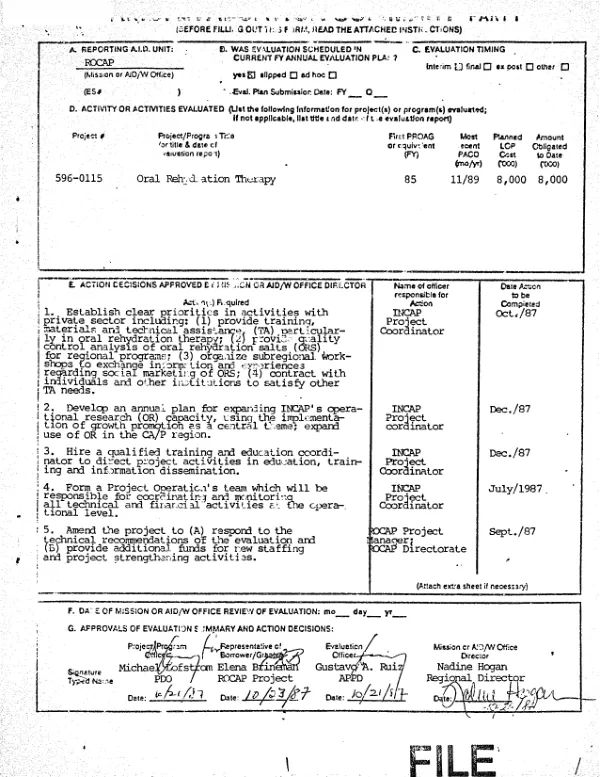
Summarizes attached evaluation of a project to increase the effective use of oral rehydration therapy (ORT), growth monitoring, and appropriate feeding practices in Central America and Panama.
1987
Sign in to readA free account is required to download.
Abstract
Interim evaluation covered the period through 8/87 and was based on document review and interviews with project and donor personnel. Overall, the project is advancing well. Progress has been made in management/administration and a young and energetic staff has been assembled, led by a capable expert in the field of child survival (CS). The project has conducted a large amount of research, prepared many documents and guides, and held a number of courses, workshops, and seminars. However, during Phase II, it will be necessary to focus the project"s limited resources on a more restricted set of priority activities in order to increase the quality of the project"s outputs. The Nutrition Institute for Central America and Panama (INCAP), which is implementing the project, is increasingly seen as a valuable resource by the Ministries of Health in the region. While institutional development was not an explicit project purpose, INCAP"s improved CS capacity means that the project can play an important role in two areas: coordination of CS activities at the regional and the national levels; and the continued development of innovative information systems and research approaches. The project could be strengthened by: developing a capability in operations research; better coordinating TA inputs; strengthening senior management, monitoring, and reporting; emphasizing coordination with the private sector; giving greater emphasis to the analysis and interpretation of information collected; developing short and simple presentations of research studies; and focusing research more on issues of technology application. In addition, some project areas may need to be dropped or refocused; these include management training, which is now well-covered by A.I.D. bilateral and other-donor support, and activities for the production and distribution of oral rehydration salts. Because the project is still in the planning and organizational phases, it is not possible to attribute impacts or lessons learned at this stage. Also, as there are other projects with similar goals to promote health services being implemented in the region, it will be difficult to measure accurately the impact of this project in the future. Therefore, mechanisms to measure project progress should be developed.