THE GLOBAL FUND TO FIGHT AIDS, TUBERCULOSIS AND MALARIA
План приверженности АРВ-терапии для Кыргызстана
The Kyrgyzstan ARV Therapy Adherence Plan outlines a logical structure for addressing individual and clinical factors affecting adherence to antiretroviral therapy (ART).
2012 · 12 pages
Sign in to readA free account is required to download.
Abstract
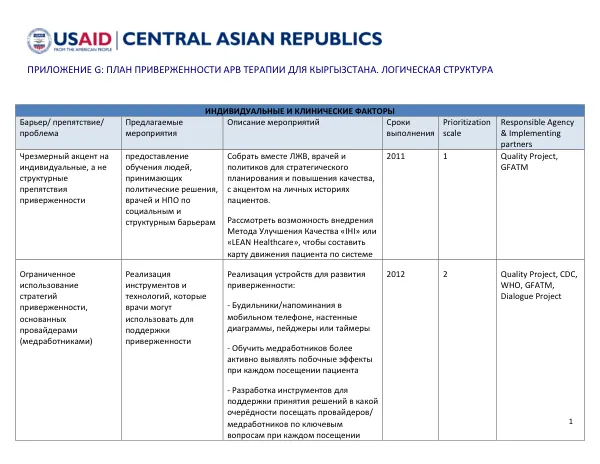
The plan identifies barriers and proposes interventions to address them. Individual factors are a significant concern, with a focus on the lack of understanding among healthcare providers about the importance of adherence and how to manage treatment successfully. To address this, the plan recommends providing education and training to healthcare providers, policymakers, and non-governmental organizations (NGOs) about social and structural barriers to adherence. One proposed intervention is to bring together healthcare providers, policymakers, and patients to develop a strategic plan for improving adherence, with a focus on personal patient stories. The plan also suggests considering the implementation of the Institute for Healthcare Improvement (IHI) or Lean Healthcare quality improvement method to map the patient journey through the system. Another individual factor is the limited use of provider-based adherence strategies, which can be addressed by implementing tools and technologies that healthcare providers can use to support adherence. This includes devices such as mobile phone reminders, wall charts, pagers, or timers, as well as training healthcare providers to actively identify side effects during each patient visit. The plan also identifies a lack of understanding among patients about the importance of adherence, which can be addressed by developing materials to support adherence, adapted to local conditions and languages. This includes translating or developing educational materials about ART for key populations, such as people who inject drugs (PWID), sex workers, and women and children. Clinical factors are also a concern, with a focus on the lack of integration of HIV services with tuberculosis (TB) and other infectious disease services. The plan recommends implementing a "one-stop shop" model, where patients can receive HIV and TB treatment under one roof, with a focus on direct observation treatment (DOT) and existing DOT services such as multidrug therapy (MDT) and TB treatment. The plan also identifies problems with the main supply chains and procurement processes, including issues with the availability of essential commodities such as infant formula, food baskets, HIV tests, ART, and medications for opportunistic infections and side effects. To address this, the plan recommends providing primary technical assistance for procurement and supply management (PSM). In terms of laboratory diagnosis, the plan recommends decentralizing access to CD4 and viral load testing, as well as clarifying the role of laboratory specialists in the testing process. Overall, the Kyrgyzstan ARV Therapy Adherence Plan aims to address individual and clinical factors affecting adherence to ART, with a focus on improving understanding among healthcare providers, patients, and policymakers, and implementing interventions to support adherence and improve access to HIV services.