GLOBAL FUND
Challenge TB ND&R Implementation Brief Krygyzstan
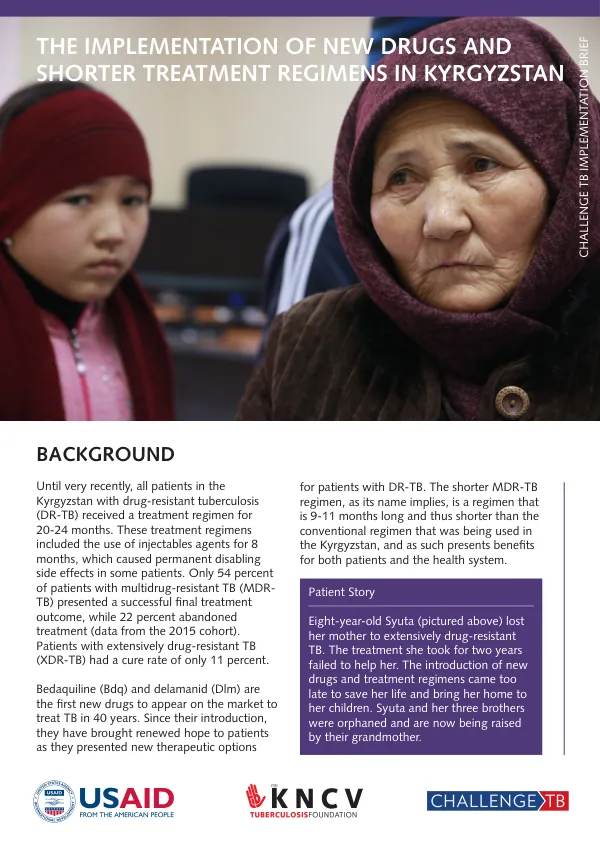
The Kyrgyzstan National TB program implemented a new treatment regimen for drug-resistant tuberculosis (DR-TB) patients, which included the use of bedaquiline and delamanid.
2019 · 8 pages
Sign in to readA free account is required to download.
Abstract
The new regimen was shorter, lasting 9-11 months, compared to the conventional 20-24 month regimen. This change presented benefits for both patients and the health system. The Challenge TB project, funded by USAID, supported the Kyrgyzstan National TB program in introducing new DR-TB diagnostic and treatment approaches. The project implemented the triage approach, which involved the use of second-line probe assay (SL-LPA) for early detection of second-line drug resistance among rifampicin-resistant TB patients. This approach helped to allocate the appropriate treatment for each patient, with those without resistance to second-line injectables and/or fluoroquinolones being placed on the shorter DR-TB treatment regimens. The Challenge TB project used a multifaceted approach to introduce new drugs and regimens, providing support in areas such as advocacy, regulatory frameworks, staff capacity-building, clinical mentoring, data analysis and sharing, and policy improvement. The project also facilitated multiple advocacy meetings and workshops to increase knowledge, interest, and awareness among national experts, and coordinated efforts among partners to unify the approach. To improve the ability of staff to manage patients, a learning program based on a "blended learning approach" was organized. This approach made the best use of human, financial, and time resources, and ensured that new competencies could be used immediately by trained staff. The 'Quality Improvement Tool for Clinical Management of DR-TB patients' (QI tool) was developed to support the quality improvement of clinical management and allow the standardization of all necessary activities. The introduction of new drugs and regimens in Kyrgyzstan was a gradual process, with site selection and assessment taking place in July-September 2015. The development of a national plan and estimation of drug needs followed in October-December 2015. The adjustment of national guidelines and standard operating procedures, as well as the national introduction plan, was completed in January-March 2016. Training of clinical and laboratory staff, on-the-job training, and patient enrollment took place in April-June 2016. Countrywide expansion and analysis of treatment results occurred in July-September 2016 and December 2016, respectively.