USAID DEC
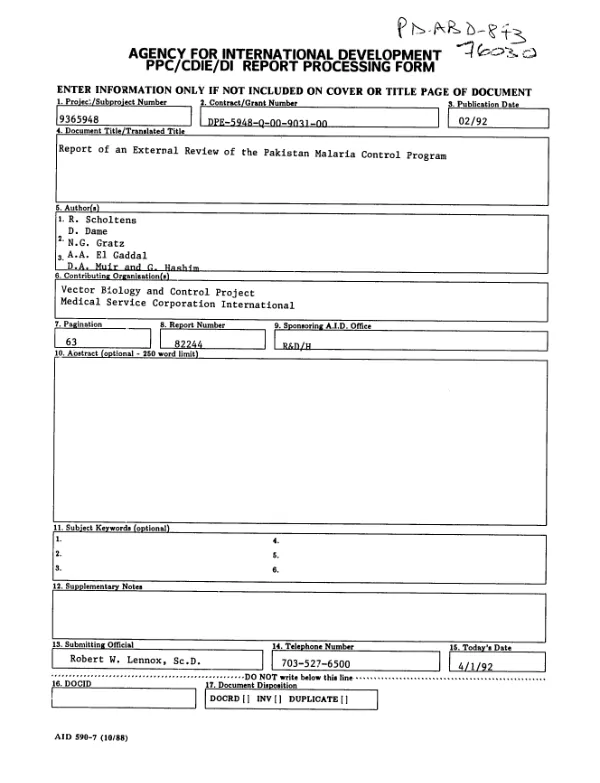
Report of an external review of the Pakistan malaria control program, August 28-September 17, 1991
Sign inMEDICAL SERVICE CORP. INTERNATIONAL
Report of an external review of the Pakistan malaria control program, August 28-September 17, 1991
Evaluates a malaria control program (MCP) in Pakistan.
Scholtens, R.|Dame, D.
Sign in to readA free account is required to download.
Abstract
Interim evaluation covers the period 1982-9/91. The current strategy has been very successful. Using case detection to target insecticide spraying has reduced insecticide usage and dependency. Malaria has been contained: levels in Punjab are very low, and though they are higher than previously recorded in Baluchistan because of neighboring political unrest, cases are not widely distributed. Although high enough in Northwest Frontier Province and Sindh to cause concern, especially since many cases are falciparum malaria, malaria incidence is not greatly different than when insecticide use was much higher. There are challenges. Since intensive post-World War II studies of malaria and its mosquito vectors provided the knowledge necessary for effective disease control, many social and environmental changes in Pakistan have rendered current control measures less potent. New, effective measures for future malaria control operations are dependent on an understanding of how these changes have altered malaria transmission dynamics. What is necessary now to minimize host-parasite contact. Available human resources and talent were impressive. If experienced health and malaria staff are organized to collect the necessary data on disease transmission and mosquito species and populations, if more staff are given the necessary training, and if operational research is given sufficient priority and support, malaria foci and the factors that influence transmission can be fully identified and this knowledge employed for its control. Then problems such as the recent findings suggesting that drug resistant forms of falciparum malaria are spreading can be confronted without widespread and expensive drug therapy. Integration of MCP activities into the basic health services is well along; 25% of all blood slides and 60% of all cases now come from health, not malaria, posts. Microscopy services are becoming more widespread and the area under passive case detection is gradually being expanded. Conditions are not as promising for entomological services and research. Entomology is currently one of the least effectively organized elements in the MCP. Information about current vectors and the extent of insecticide resistance are inadequate; in particular, issues such as the importance of Anopheles stephensi as a vector, adequate information on anopheline breeding sites and densities, and evidence linking vectors and malaria outbreaks receive much less attention than needed. Microscopist training and training of spraymen in safe handling of insecticides has been emphasized recently, but a shortage of funds for trainee travel and per diem remains a constraint to more widespread and effective training programs. There are some encouraging developments in the operational research program at the National Institute of Malaria Research and Training, but that institution continues to be handicapped by a shortage of scientific staff. Major conclusions are as follows. (1) Gains in malaria control can be sustained but external assistance must be continued. (2) Districts are a critical operational level. District health officers must be better indoctrinated on malaria. District and subdistrict disease surveillance and reporting and entomological monitoring must be strengthened. (3) Training and operational research deserve much higher priority in the future. (Author abstract)
Related documents