DELOITTE CONSULTING, LLP
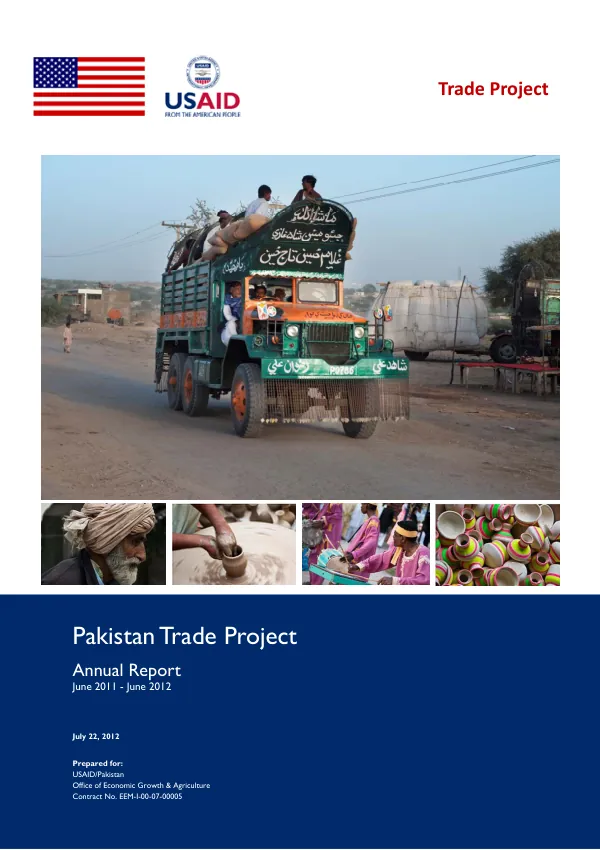
Pakistan Trade Project Annual Report (June 2011 - June 2012)
The Trade Project in Pakistan aimed to collaborate with the Government of Pakistan (GoP) and the private sector to resolve trade challenges and support 'second generation' trade reform.
2012 · 35 pages
Sign in to readA free account is required to download.
Abstract
The project's goal was to encourage improvements in customs and trade facilitation, eliminate anti-export bias in trade policy, and enable increased bilateral and regional trade with Pakistan's neighbors. The project was organized into four components: Component 1, dedicated to improving Pakistan's trade environment; Component 2, focused on increasing trade at Pakistani borders; Component 3, aimed at supporting Reconstruction Opportunity Zones; and Component 0, established to provide project management, operational, and life support services for the project. Key stakeholders involved in the project included the Ministry of Commerce, the Trade Development Authority of Pakistan, the Federal Board of Revenue/Customs, and the Board of Investment from the public sector, and the Pakistan National Committee of the International Chambers of Commerce, the South Asian Association for Regional Cooperation, trade associations, and trade promotion organizations from the private sector. During the year 2011-2012, the Trade Project achieved several notable milestones. The project launched the pilot "Women in Trade" Management Training & Mentorship Program, which provided opportunities for recent women graduates to explore a career in international trade. The program selected 17 women graduates out of a pool of 140 candidates, with all receiving job offers in the trade sector. The Trade Project also trained 121 individuals in "Enhancing Agricultural Exports" workshops in Islamabad, Karachi, Lahore, and Quetta. Additionally, the project introduced a new form of financial guarantee, Customs' Insurance Guarantees, for transit goods per the requirements of the 2010 Afghanistan-Pakistan Transit Trade Agreement. Furthermore, the project facilitated a public-private sector agreement between the Federal Board of Revenue and the landowner of the site at Torkham, where import and export weighbridges will be installed. The project also established file-sharing capabilities at the Board of Investment through the installation of Information and Communications Technology equipment, software, and capacity building training for staff. The Trade Project also conducted on-site assessments of the Customs' border infrastructure, processes, and current capabilities at the Pakistan-India border stations of Khokrapar-Munabao, Sindh, and Wagah-Attari, Punjab. The project finalized a study on Pakistan-India trade relations, entitled "A Primer: Pakistan-India Trade Relations (1947-2012)," in collaboration with the Beaconhouse National University's Institute of Public Policy. In Component 1, the Trade Project aimed to assist the Government of Pakistan and private sector stakeholders with the implementation of policy, regulatory, procedural, and other reform efforts that affect the movement of goods across Pakistan's borders. The project's activities sought to strengthen the overall trade environment in Pakistan by reducing the complexity, cost, and time required to export and import goods. The Trade Project's counterparts within the Government of Pakistan and private sector stakeholders included the Ministry of Commerce, the Trade Development Authority of Pakistan, the Board of Investment, the Pakistan National Committee of the International Chamber of Commerce, and the Federal Board of Revenue/Customs. The project's outcomes as a result of Trade Project assistance included the "Women in Trade" Management Training & Mentorship Program, which provided opportunities for recent women graduates to explore a career in international trade. The project also initiated efforts to support the liberalization of regional trade by commissioning the development of a comprehensive set of studies on Pakistan-India trade relations. The Trade Project also delivered a nationwide series of workshops on "Enhancing Agricultural Exports" in Islamabad, Karachi, Lahore, and Quetta. The project signed a Letter of Cooperation with the Pakistan National Committee-International Chamber of Commerce to assist in implementing the TIR Convention in Pakistan. The Trade Project also began the development of the "Women in Trade" Portal, a web-based trade facilitation tool to provide women entrepreneurs with visibility to international trade opportunities. The project completed the first User Acceptance Test for the Trade Portal and finalized the first deliverable on Pakistan-India trade relations research study.
Related documents