DELOITTE CONSULTING, LLP
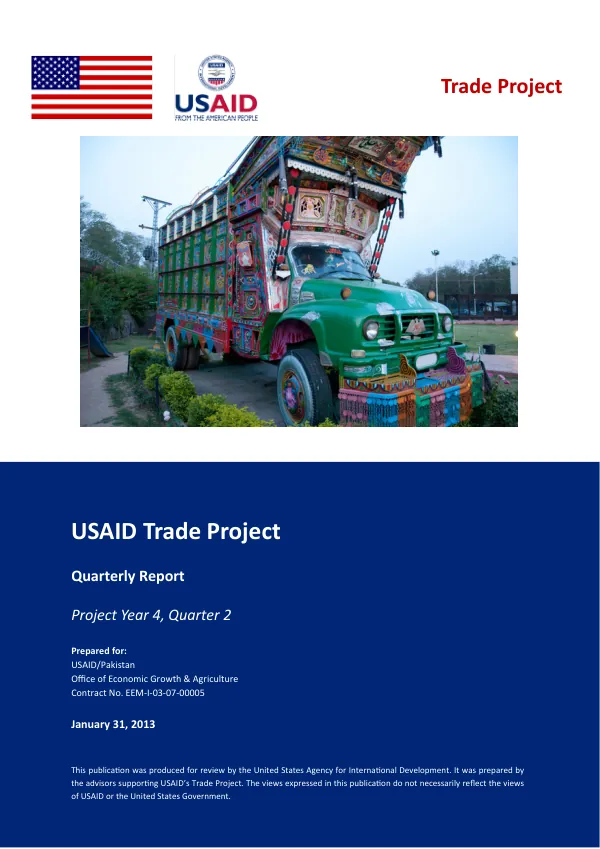
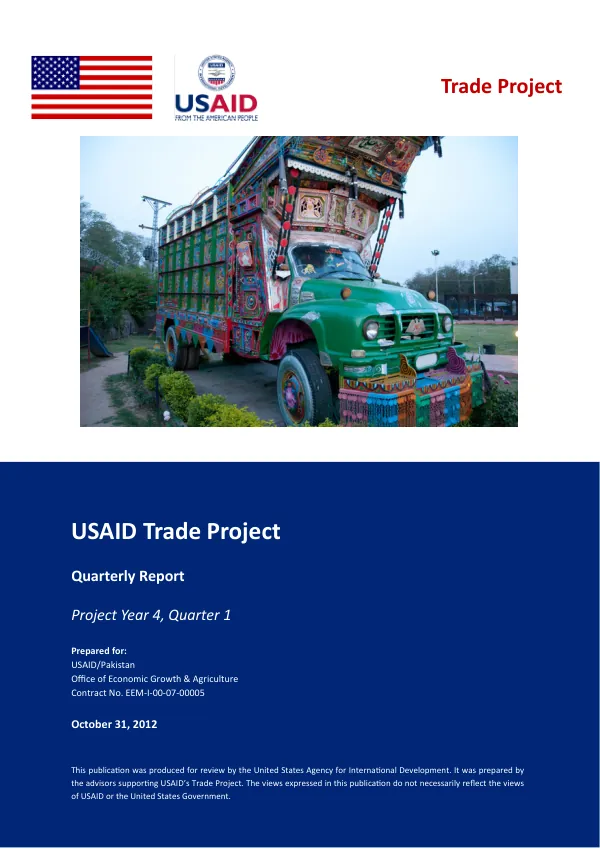
USAID Trade Project Quarterly Report: Project Year 4, Quarter 1
The Trade Project, a collaborative effort between the US Agency for International Development (USAID) and the Government of Pakistan, aims to resolve trade challenges and support trade reform through technical assistance.
2012 · 17 pages
Sign in to readA free account is required to download.
Abstract
The project's objective is to encourage improvements in customs and trade facilitation, eliminate anti-export bias in trade policy, and enable increased bilateral and regional trade with Pakistan's neighbors. The project is organized into four components: Component 1, dedicated to improving Pakistan's trade environment; Component 2, focused on increasing trade at Pakistani borders; Component 3, aimed at supporting Reconstruction Opportunity Zones; and Component 0, established to provide project management, operational, and life support. A team of expatriate and national staff work alongside the Government of Pakistan and private sector stakeholders to meet project objectives. Some notable achievements in Year 4, Quarter 1 include the completion of a study on Pakistan-India trade relations, entitled "Impact of Non-Tariff Barriers on Trade between Pakistan and India," in collaboration with the Beaconhouse National University's Institute of Public Policy. The Trade Project also administered a survey to gauge the perception, attitude, and opinion of public and private sector stakeholders on Pakistan-India trade relations. Additionally, the project provided internship opportunities to 49 recent women graduates through the "Women in Trade" Management Training and Mentorship Program. Component 1, Improved Trade Environment, aims to assist Government of Pakistan efforts that affect the movement of goods across Pakistan's borders. The component seeks to strengthen the overall trade environment by reducing the cost and time required to export and import goods. Component 1 counterparts and stakeholders include the Ministry of Commerce, the Trade Development Authority of Pakistan, the National Tariff Commission, and the Federal Board of Revenue/Customs, among others. Research on trade liberalization with India is a key focus area for Component 1. The Trade Project completed the second report on Pakistan-India trade issues, entitled "Impact of Non-Tariff Barriers," and established a technical working group with the Ministry of Commerce's Foreign Trade Wing. The group will coordinate on current ongoing initiatives and planning for future activities, including augmenting the existing set of research with studies analyzing the impact of trade liberalization with India on the intra-industry and intra-services sectors. The Pakistan-India Stakeholder Perception and Awareness Survey, administered in July 2012, gauged the perception, attitude, and opinion of public and private sector stakeholders on Pakistan-India trade relations. Results indicate overall support for trade liberalization among civil servants, academia, and private firms, with reservations from the armed forces. The survey also highlighted a lack of knowledge and understanding on the concept of trade defense laws and the concept of Most Favored Nation. Strengthening the National Tariff Commission is another key area of focus for Component 1. The Trade Project began efforts to support the NTC in improving their capabilities to manage the provisions of World Trade Organization (WTO) compliant trade defense laws. A rapid training needs assessment was completed to analyze the organization's current "learning" structure and determine future training requirements. Preliminary results indicate that the NTC needs a structured approach to develop and maintain a constant learning environment in order to effectively administer trade laws. The "Women in Trade" (WIT) Portal is a key initiative of the Trade Project, aimed at promoting women's participation in trade and commerce. The portal provides a platform for women entrepreneurs to access information, resources, and networking opportunities. The project also aims to support the development of women's trade-related skills and knowledge through training and mentorship programs.
Related documents