DELOITTE CONSULTING, LLP
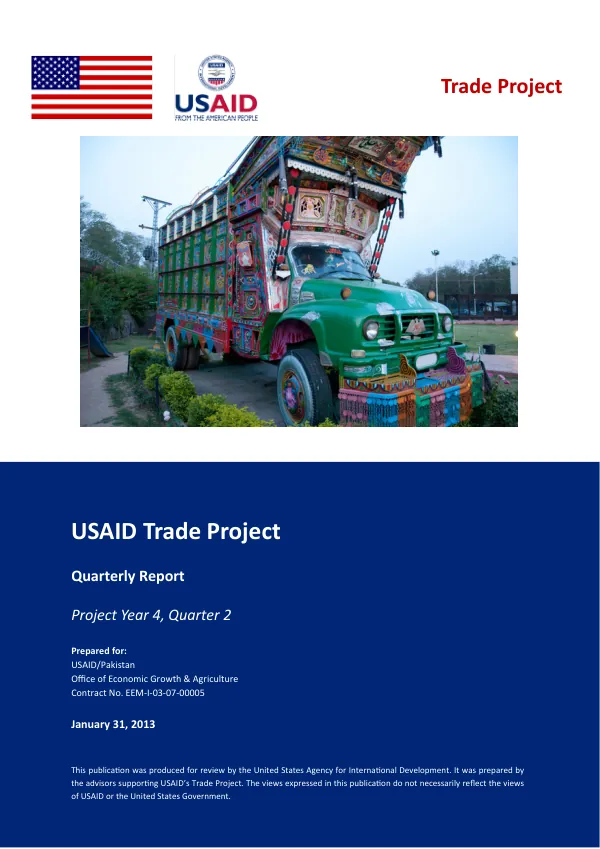
USAID Trade Project Quarterly Report: Project Year 4, Quarter 2
The Trade Project, a collaborative effort between the US Agency for International Development (USAID) and the Government of Pakistan, aims to improve the trade environment and increase trade at Pakistani borders.
2013 · 18 pages
Sign in to readA free account is required to download.
Abstract
The project is organized into four components, with Component 1 focused on improving the trade environment. Component 1 seeks to strengthen the overall trade environment by reducing the cost and time required to export and import goods. The Ministry of Commerce (MoC), Trade Development Authority of Pakistan (TDAP), National Tariff Commission (NTC), and Federal Board of Revenue/Customs (FBR) are key counterparts and stakeholders in this component. Research on trade liberalization with India is a key activity within Component 1. A study, "Determining the Impact of Pakistan-India Trade: A Sectoral Analysis," was completed in collaboration with the Beaconhouse National University's Institute of Public Policy. The study aims to provide fact-based research to support informed decision-making by Government of Pakistan policy makers and raise awareness on Pakistan-India trade issues. The Trade Project also assisted the National Tariff Commission in conducting a Human Resource Training Needs Assessment, which highlighted the need for specific investigation-related training and the establishment of a knowledge management mechanism. Additionally, an Information and Communications Technology (ICT) Needs Assessment was initiated to identify technology barriers and opportunities for improvement. The Revised Kyoto Convention (RKC) is another key area of focus within Component 1. Trade Project advisors are working with a Pakistani law firm to conduct a legal gap analysis of the RKC, which aims to guide the efforts of the FBR to align its governing principles with international best practices. The "Women in Trade" (WIT) Portal is also being developed and tested, with discussions underway with SAARC-CCI and TradeKey for the management and sustainability of the portal. The WIT Portal aims to provide opportunities for women in trade management and mentorship. In Quarter 1 of Year 4, the Trade Project achieved several notable milestones, including finalizing a study on Pakistan-India trade relations, completing a human resource needs assessment at the National Tariff Commission, and initiating a legal gap analysis of Pakistan's customs regime vis-à-vis the Revised Kyoto Convention. The project also facilitated meetings between USAID Afghanistan, USAID Pakistan, and Afghan transit trade stakeholders to discuss APTTA implementation issues. The Trade Project continues to work closely with the Government of Pakistan and private sector stakeholders to address trade challenges and support trade reform. The project's efforts aim to improve the trade environment, increase trade at Pakistani borders, and promote economic growth and development in Pakistan.
Related documents