FHI 360
Pamoja Tuwalee/FHI 360 October – December 2013 Quarterly Report
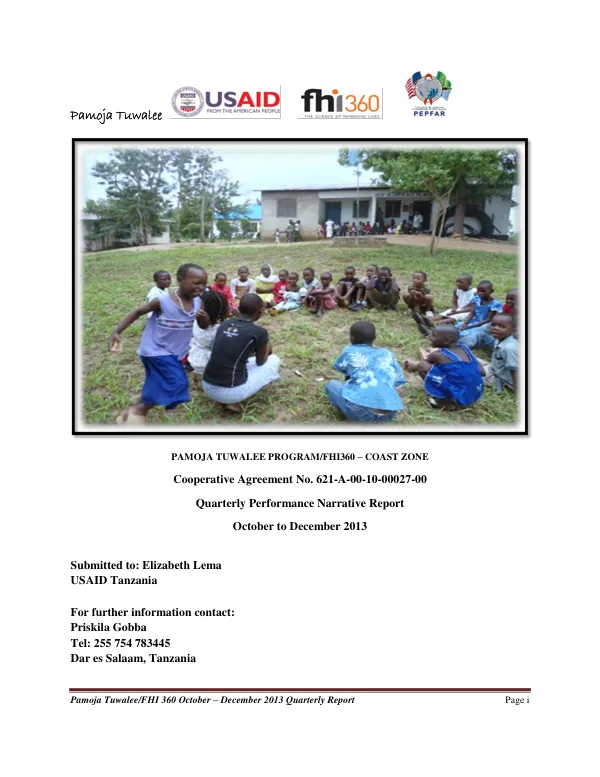
The Pamoja Tuwalee Program is a five-year initiative implemented by FHI 360 in the Coast Zone of Tanzania, funded by the President's Emergency Plan for AIDS Relief (PEPFAR) through the United States Agency for International Development (USAID).
2013 · 43 pages
Sign in to readA free account is required to download.
Abstract
The program aims to improve the quality of life and well-being of Most Vulnerable Children (MVC) and their households by empowering households and communities to provide comprehensive and sustainable care, support, and protection. The program targets 25 districts in the Coast Zone, including two in Dar es Salaam, six in Morogoro, seven in Coast, and ten in Zanzibar. The estimated population in the Coast Zone is 8,985,270, with Dar es Salaam having the highest number of people, followed by Morogoro, Zanzibar islands, and Coast region. The estimated proportion of children (0-18 years) is 51% of the general population, suggesting an estimated 4,582,488 children in the Coast Zone. The program's goal is to empower households and communities to provide comprehensive and sustainable care, support, and protection to MVC and their households. To achieve this, the program focuses on four objectives: MVC support, economic strengthening, capacity building, and child protection. Under MVC support, the program aims to provide at least one core service to MVC while building the capacity of caretakers to meet MVC needs. In the reporting period, 51,747 MVC received at least one core service, representing 79% of the FY 2014 target. The program also focuses on economic strengthening, which involves supporting MVC households to raise funds for their children. During the reporting period, MVC households raised a total of TZS 7,188,800 (US$ 4,493) for their children. Additionally, the program facilitated the establishment of 22 new Saving and Internal Lending Communities (SILC) groups, composed of 529 members, with a contribution of TZS 753,800 (US$ 471) for MVC Fund. Under capacity building, the program supports its implementing partners to implement their capacity building plans developed in the last year. The program aims to ensure that LGAs and community members take over MVC support as the program approaches the end of its lifetime. In the reporting period, the program supported the establishment of five children clubs, making a total of 398 clubs with 12,704 children receiving different services, including psychosocial support, youth reproductive health, and HIV prevention. The program also made a remarkable national contribution in establishing one-stop center models for addressing child abuse and GBV cases in Dar es Salaam. The center was launched by the Ilala District Commissioner and marked by key government officials and USAID representatives. Since the launch, a total of 67 cases have been reported and served. The program's progress is a result of continuous community sensitization, which contributed TZS 21,052,000 (US$ 13,158) for MVC support. The program's achievements demonstrate its commitment to improving the quality of life and well-being of MVC and their households in the Coast Zone of Tanzania.
Related documents