FHI 360
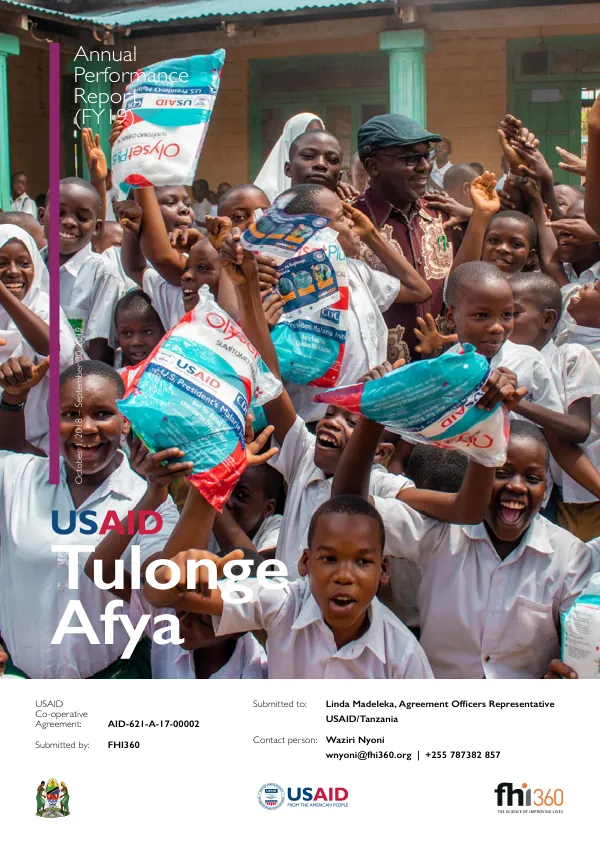
USAID TULONGE AFYA QUARTERLY REPORT | OCT 2018 - DEC 2018
The USAID Tulonge Afya project aims to improve the health status of Tanzanians by transforming socio-cultural norms and supporting the adoption of healthier behaviors.
2018 · 23 pages
Sign in to readA free account is required to download.
Abstract
The project focuses on addressing key social and cultural norms and social behavior change (SBC) needs to achieve the following results: improved ability of individuals to practice healthy behaviors, strengthened community support for health behaviors, and improved systems for coordination and implementation of SBCC interventions. In the first quarter of FY19, the project made significant progress in reaching individuals with health information and promoting healthy behaviors. Through Furaha Yangu interpersonal communication (IPC) activities, a total of 536,592 individuals were reached, with 34% being males and 66% females. The project also trained 17 Community Health Workers (CHWs) to carry out the Misungwi malaria study, and 14 individuals received training on how to present SBCC health issues to community radio presenters. The project has also made progress in strengthening community support for health behaviors. In the first quarter, 300,490 females and 236,102 males were reached through Furaha Yangu IPC activities, with a total of 7,928 individuals reached through Furaha Yangu mid-media and small group IPC during football matches. The project has also developed new materials to support ART initiation and adherence yields through community activities with PLHIV. In addition, the project has made progress in improving systems for coordination and implementation of SBCC interventions. The project has strengthened its relationship with the PORALG and MoHCDGEC, and is working closely with the Health Promotion Section to ensure that all SBCC activities are aligned and support those that the Ministry has in place or has been recently launched. The project has also made progress in research and evaluation. The Lost to Follow Up Research has completed their data collection and analysis has begun, and the concept note for the rapid audience insights in TB is finalized. Secondary analysis on the baseline is underway as is the evaluation of Furaha Yangu Phase I, and the Omnibus Survey results on Furaha Yangu are included in this report. The project's activities are focused on 15 districts, with the engagement of a further 12 CSOs to deliver and implement mid-media and community-based activities. Community radio stations have been engaged, and workplans are in place for the co-design and delivery of reality radio programs with the target groups. The project has also conducted orientations for CSOs and sub-partners in fresh and engaging youth materials and tools that engage young people in a fun and participatory way over a series of sessions to learn about the advantages of modern contraceptive methods. The project's achievements in the first quarter of FY19 demonstrate its commitment to improving the health status of Tanzanians by transforming socio-cultural norms and supporting the adoption of healthier behaviors. The project's progress in reaching individuals with health information, promoting healthy behaviors, and improving systems for coordination and implementation of SBCC interventions is a significant step towards achieving its results.
Related documents