GLOBAL COMMUNITIES
Paradelante Program Annual Report FY21
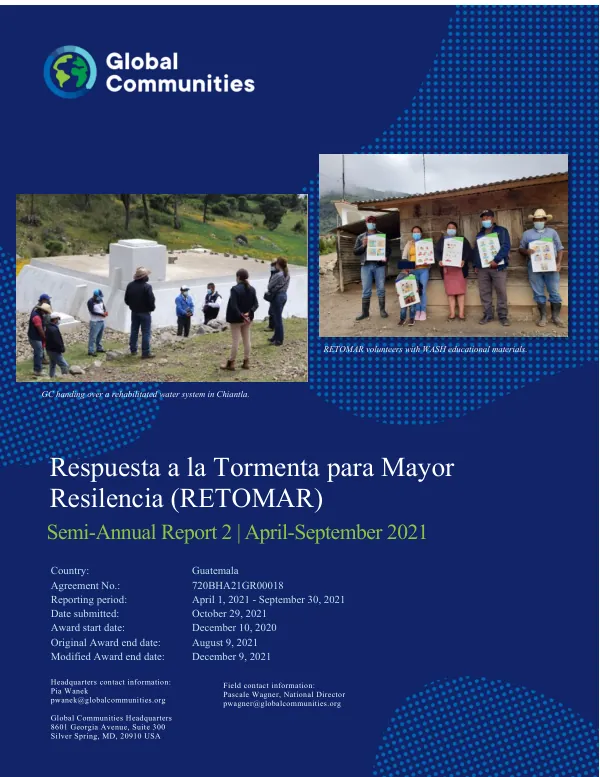
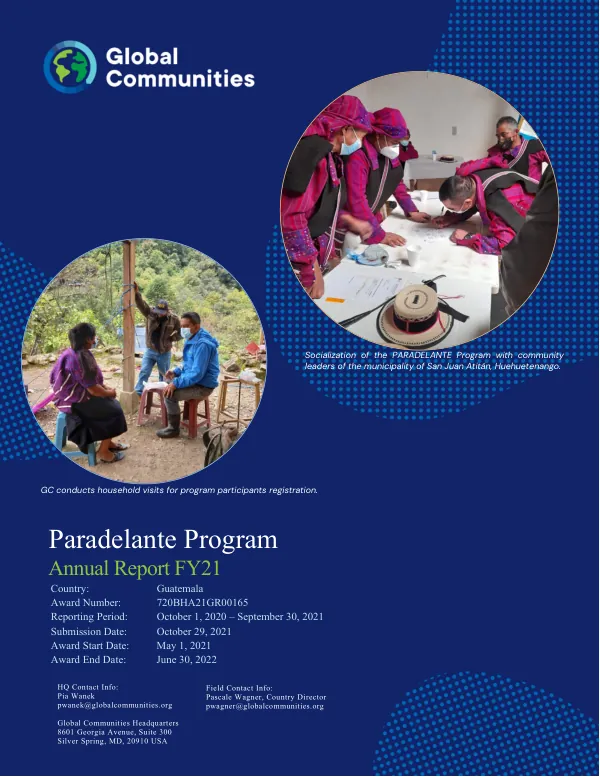
The Paradelante Program is a 14-month initiative funded by the USAID's Bureau for Humanitarian Assistance (BHA) with a total budget of $11.4 million.
2021 · 10 pages
Sign in to readA free account is required to download.
Abstract
The program aims to support highly vulnerable and food insecure households in the Department of Huehuetenango, Guatemala, who are facing the triple crises of sequential droughts, COVID-19-related income constraints, and damage from recent hurricanes. The program focuses on improving food security, health services, and livelihoods through various interventions. The program targets 89 communities in the municipalities of San Juan Atitán, Santiago Chimaltenango, Nentón, Tectitán, and San Gaspar Ixil. Global Communities (GC) has recruited and hired 127 personnel, including a leadership team, supervisors, field technicians, M&E team, and administrative and support personnel. The program has presented its strategy and implementation plan to various stakeholders, including the Cooperation Directorate of the Secretariat for Food and Nutritional Security (SESAN) and the Departmental and Municipal Commission for Food and Nutritional Security (CODESAN/COMUSAN). The program has identified 4,590 program participants, but activities have not started yet. The program is prioritizing the procurement of cash transfer service vendors, and a quick survey was conducted at the municipal level to explore the services and types of infrastructure in place to carry out the multi-purpose cash transfers. Banrural agencies have the greatest presence in the municipalities covered, with four banking agencies, six rural savings banks, and one 5B ATM to carry out the transfer process. The program's overall performance is focused on five sectors: Multi-Purpose Cash Assistance (MPCA), Economic Recovery and Market Systems (ERMS), Water, Sanitation, and Hygiene (WASH), Agriculture, and Health. The program aims to support participating households with multipurpose cash transfers, resumption and/or expansion of income-generating activities, creation of savings and loan groups, and small-scale rehabilitation/improvement of priority water points. The program addresses critical needs and fills important gaps in ongoing emergency programs. The program's management team has developed a strategy for each sector and an implementation plan for the entire program. The program has also presented its plan to various stakeholders, including the validation of communities to be covered by the program. The validation exercise resulted in the prioritization of 89 communities based on institutional criteria such as the main causes of morbidity, the existence of cases of children with acute malnutrition, livelihoods affected by storms, level of poverty, and absence of other NGOs in the area. The program's overall goal is to support highly vulnerable and food insecure households in the Department of Huehuetenango, Guatemala, to recover from the triple crises of sequential droughts, COVID-19-related income constraints, and damage from recent hurricanes. The program aims to improve food security, health services, and livelihoods through various interventions and address critical needs and fill important gaps in ongoing emergency programs.
Related documents