EAST WEST MANAGEMENT INSTITUTE, INC.
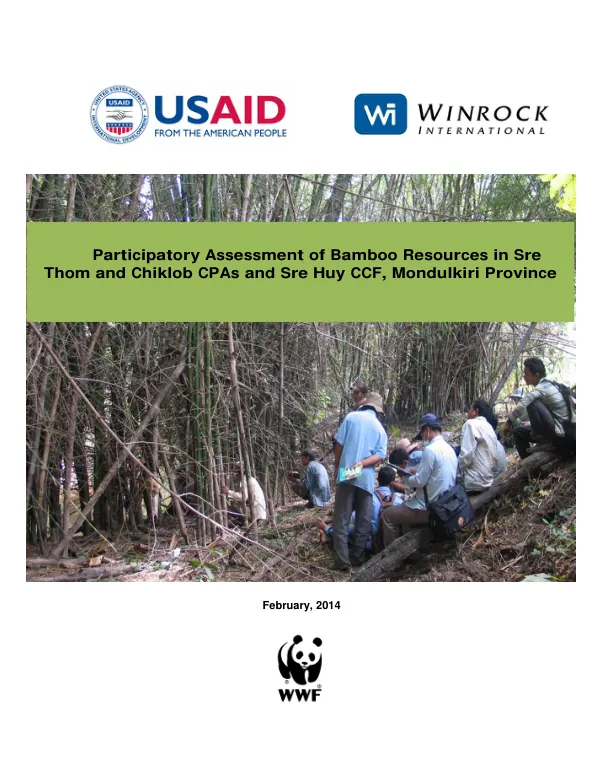
Participatory Assessment of Bamboo Resources in Mondulkiri Province
A participatory assessment of bamboo resources was conducted in Sre Thom and Chiklob Community Protected Areas (CPAs) and Sre Huy Community Conservation Forest (CCF) in Mondulkiri Province.
2014 · 31 pages
Sign in to readA free account is required to download.
Abstract
The study aimed to identify potential commercial species, assess abundance, and estimate annual regeneration rate and harvest volume. This assessment was part of the Cambodia Supporting Forests and Biodiversity project, a joint initiative of Winrock International, WWF Cambodia, and other organizations. The study area covered a total of 698 hectares of bamboo forests, with 112 hectares in Sre Huy, 336 hectares in Chiklob, and 250 hectares in Sre Thom. Nine out of 18 identified bamboo groves along streams within and adjacent to the three CPAs and CCFs were selected for inventory using 50m x 50m sample plots. Four species, Russey Roleak, Russey Prey/Rosorb, Russey Khley, and Russey Tronung Moin, were identified as potential for commercial use. The study found that the current population of Russey Roleak and Russey Prey/Rosorb is 737,209 adult culms, and 707,624 juvenile culms; Russey Khley has 37,285 adult culms, and 31,354 juvenile culms; and Russey Tronung Moin has 8,781 adult culms, and 7,884 juvenile culms. The annual culm regeneration of the entire study area is estimated to be 339,140 culms of Russey Roleak, 132,860 culms of Russey Prey, 6,675 culms of Russey Tronung Moin, and 23,963 culms of Russey Khley. The study recommended that the annual harvest of juvenile culms can be implemented at the level of its regeneration rate (4-5 culms annually). Bamboo culms should be cut at ground level to allow growing of healthy bamboo shoots and culms. Bamboo harvest should be carried out in November to April to avoid destroying the bamboo shoots and young culms. The study also highlighted the potential of bamboo enterprise to address deforestation and enhance rural livelihoods through value addition to bamboo products and access to markets. Proper management of bamboo resources can help mitigate climate change through carbon sequestration and contribute to habitat and wildlife protection in the Eastern Plains Landscape.