J.D.G. COMMUNICATIONS, INC.
Partnering for Impact: PPPs and USAID’s Global Development Alliance Approach
The U.S.
2011 · 2 pages
Sign in to readA free account is required to download.
Abstract
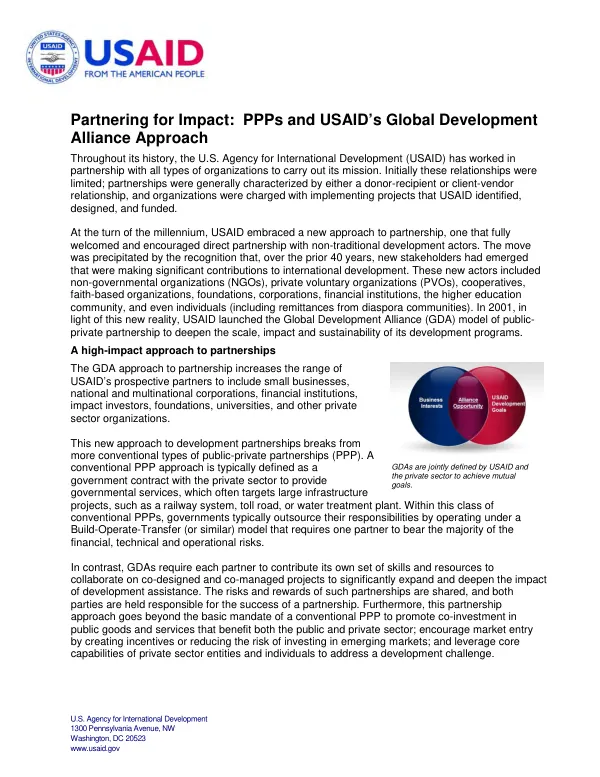
Agency for International Development (USAID) has a long history of partnering with various organizations to carry out its mission. Initially, these relationships were limited, with partnerships characterized by a donor-recipient or client-vendor relationship. Organizations were charged with implementing projects that USAID identified, designed, and funded. At the turn of the millennium, USAID adopted a new approach to partnership, one that fully welcomed and encouraged direct partnership with non-traditional development actors. This move was precipitated by the recognition that new stakeholders had emerged, making significant contributions to international development. These new actors included non-governmental organizations (NGOs), private voluntary organizations (PVOs), cooperatives, faith-based organizations, foundations, corporations, financial institutions, the higher education community, and individuals. In 2001, USAID launched the Global Development Alliance (GDA) model of public-private partnership to deepen the scale, impact, and sustainability of its development programs. The GDA approach increases the range of USAID's prospective partners to include small businesses, national and multinational corporations, financial institutions, impact investors, foundations, universities, and other private sector organizations. This new approach to development partnerships breaks from more conventional types of public-private partnerships (PPP). Conventional PPPs are typically defined as government contracts with the private sector to provide governmental services, often targeting large infrastructure projects. In contrast, GDAs require each partner to contribute its own set of skills and resources to collaborate on co-designed and co-managed projects to significantly expand and deepen the impact of development assistance. Six key criteria distinguish GDAs from conventional PPPs. First, at least 1:1 leverage of USAID resources is required, with resource partners matching USAID's investment on an equal basis. Second, common goals are defined for all partners, with partners becoming co-donors with USAID. Third, a jointly-defined solution to a social or economic development problem is developed, with partners working together to address challenges. Fourth, non-traditional resource partners, such as companies and foundations, are encouraged to participate. Fifth, shared resources, risks, and results are preferred, with a focus on scale of impact. Sixth, sustainable approaches to development are promoted, with collaboration activities jointly designed to create positive development outcomes linked to business interests. The GDA model requires partners to share resources, risks, and responsibilities among all parties involved, creating a collaborative environment that can lead to greater impact, opportunity for bigger reach, and longer-term sustainability. This approach helps to create positive development outcomes that are linked to business interests, making private sector engagement more likely to continue even after USAID funding or in-kind support ends, generating truly sustainable progress.