USAID DEC
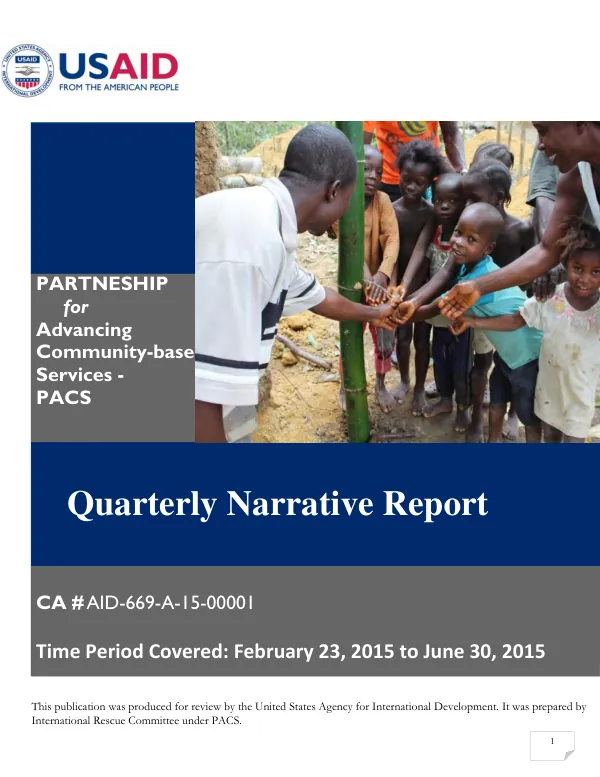
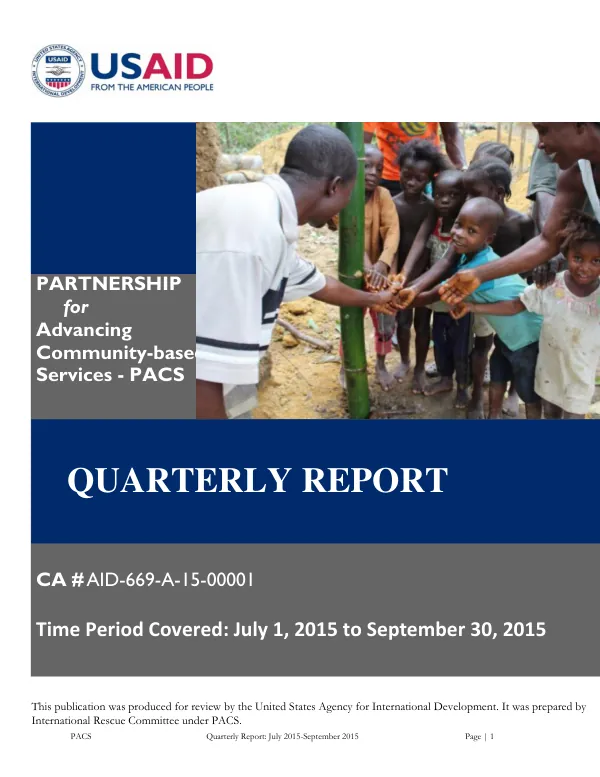
Partnerships for Advancing Community Services (PACS) Quarterly Report: July 2015-September 2015
Sign inGLOBAL COMMUNITIES
Partnerships for Advancing Community Services (PACS) Quarterly Report: July 2015-September 2015
The PACS project aims to build the capacity of Ministry counterparts and local civil society organizations to manage and deliver quality community-based services in Liberia.
2015 · 32 pages
Sign in to readA free account is required to download.
Abstract
The project focuses on Bong, Lofa, and Nimba counties, and brings together a qualified set of international and national NGOs to advance community-based services for health. The project goal is to build the capacity of Ministry counterparts and local civil society organizations to manage and deliver quality community-based services, while emphasizing alignment with national guidance documents and close coordination with Government of Liberia (GOL) Ministries, other USAID partners, as well as implementers funded through other donors. The PACS project has several objectives, including broadening the capacity of Ministry of Health (MOH), Community Health Teams (CHTs), NGOs, and community organizations to implement and manage community services, increasing the availability of community-based health and social welfare services, improving health-seeking behavior and practice, and improving access to safe WASH services. The project is structured according to the areas of intervention outlined in the Program's description and work plan, and consists of three parts: introduction and synthesis of principal results, project strategies and approaches, and key challenges and activities planned for the upcoming quarter. During the period July 1, 2015-September 30, 2015, the project management team prepared and submitted the PACS modification technical proposal and budget, prepared the PACS year 2 annual implementation plan, mobilized logistics material for the PACS modification, and prepared modifications to the sub-grant agreements between IRC and consortium partners' members. The project facilitated MOH units, completed self-assessments for three MOH units, successfully negotiated and finalized technical agreements with the MOH units, and maintained coordination and collaboration with other key USAID implementing partners. The project achieved several results, including broadened capacity of the MOH, CHTs, NGOs/CBOs/CSOs to implement and manage community services, and increased availability of community-based health and social welfare services. The project also improved health-seeking behavior and practice, and improved access to safe WASH services. The project team maintained coordination and collaboration with other key USAID implementing partners, and successfully negotiated and finalized technical agreements with the MOH units. The project faced several challenges, including institutional limitations within the Ministry of Health, Department of Social Protection, and Ministry of Public Works, as well as other key ministry departments. The Ebola Virus Disease (EVD) outbreak in 2014 highlighted suboptimal organization and management of health services, and underlined a need for substantial investment in institutional capacity building to develop and implement strategies aimed at strengthening health systems and the delivery of health services. The project team plans to address these challenges by implementing a comprehensive and fully participatory approach to institutional strengthening and capacity building, which will go beyond knowledge transfer and address context-specific factors, including those issues critical for a post-EVD environment. The project team will also continue to maintain coordination and collaboration with other key USAID implementing partners, and will work to improve health-seeking behavior and practice, and improve access to safe WASH services.
Related documents