ACTION AGAINST HUNGER
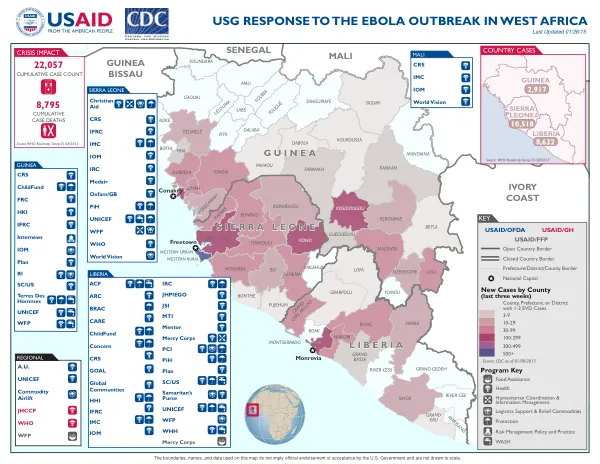
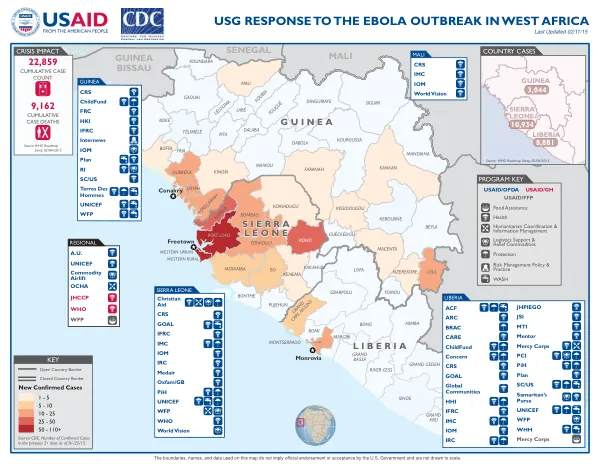
USG RESPONSE TO THE EBOLA OUTBREAK IN WEST AFRICA
The Ebola outbreak in West Africa began in 2014, with the first reported cases in Guinea.
2015 · 1 pages
Sign in to readA free account is required to download.
Abstract
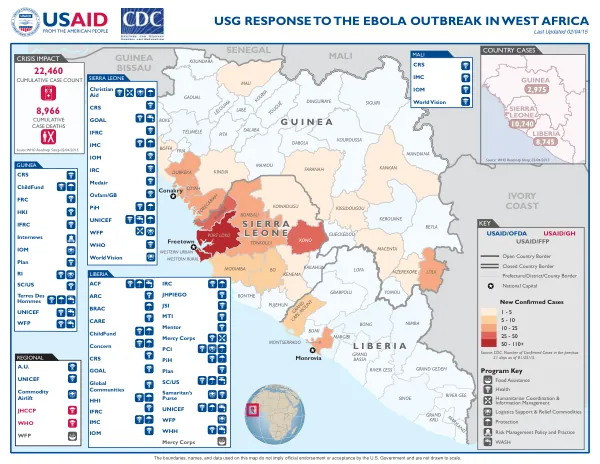
The virus spread rapidly across the region, affecting Guinea, Sierra Leone, and Liberia. By February 2015, the cumulative case count had reached 22,460, with 8,966 reported deaths. The outbreak had a significant impact on the affected countries, with Guinea experiencing the highest number of cases. The country's capital, Conakry, was particularly hard hit, with a cumulative case count of 2,975. Liberia's capital, Monrovia, had a cumulative case count of 8,745, while Sierra Leone's capital, Freetown, had a cumulative case count of 10,740. The US Government responded to the outbreak with a significant humanitarian effort. The response included food assistance, health services, humanitarian coordination and information management, logistics support and relief commodities, protection, risk management policy and practice, and water, sanitation, and hygiene (WASH) services. Multiple non-governmental organizations (NGOs) were involved in the response, including ACF, ARC, BRAC, CARE, ChildFund, Concern, CRS, GOAL, Global Communities, HHI, IFRC, IMC, IOM, IRC, JHPIEGO, JSI, MTI, Mentor, Mercy Corps, PCI, PiH, Plan, SC/US, Samaritan's Purse, UNICEF, and WFP. The response also included commodity airlifts, with the US Government providing significant support to the affected countries. The World Health Organization (WHO) played a key role in coordinating the response, working closely with the US Government and other partners to contain the outbreak. The response efforts were also supported by the African Union (A.U.) and the United Nations Children's Fund (UNICEF). The outbreak had a significant impact on the affected countries, with widespread disruption to healthcare systems, economies, and communities. The response efforts were critical in containing the outbreak and preventing further spread of the virus.
Related documents