INTERNATIONAL MEDICAL CORPS
Ebola Community Action Platform II FY15 Q4 Quarterly Report July-September 2015
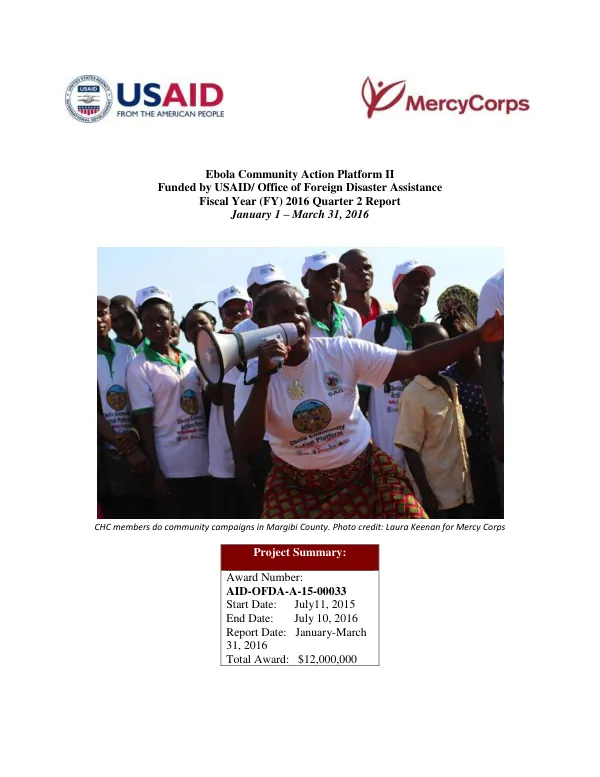
The Ebola Community Action Platform II (ECAP 2) is a program funded by USAID's Office of Foreign Disaster Assistance, with a total award of $12,000,000.
2015 · 8 pages
Sign in to readA free account is required to download.
Abstract
The program aims to support civil society organizations and community structures in building preparedness against a possible future outbreak of Ebola Virus Disease (EVD) and other diseases with similar symptoms. ECAP 2 is a follow-on to the successful ECAP program, which enhanced awareness and uptake of behaviors that reduced EVD transmission across Liberia. The program has met all of its work plan objectives for the first quarter of program implementation, which represents the startup period of the program. During this quarter, ECAP 2 conducted a Request for Application (RFA) process to support partner selection, met with pre-approved partners to discuss field research, conducted trainings for partners, met with various stakeholders, and designed monitoring and evaluation (M&E) tools. Partnerships with twenty-five ECAP 2 sub-awardees were solidified over the course of the quarter, through both a non-competitive process and a competitive process. The program addresses four main areas to achieve its goals and objectives. In the area of civil society engagement, Mercy Corps is working through civil society to ensure a broad reach throughout the country and build the capacity of local organizations to prevent and respond to potential future health emergencies. Partnerships with twenty-five ECAP 2 sub-awardees were solidified over the course of the quarter, through both a non-competitive process and a competitive process. The six partners approved through a non-competitive process all successfully implemented aspects of the original ECAP 1 program, and thus were pre-selected in order to enable field work to commence in a timely fashion. In the area of health systems and clinical support, ECAP 2 aims to strengthen community health structures and link them to the Ministry of Health community health services structures. The program also aims to increase public awareness on EVD and other preventable illnesses with high morbidity and mortality rates. Partners selected through the competitive process will be responsible for strengthening community health structures and linking them to the MoH community health services structures. These partners will also be responsible for increasing public awareness on EVD and other preventable illnesses with high morbidity and mortality rates. The security context and situation overview indicate that the country was declared Ebola-free once more on September 3, 2015, after a short outbreak of Ebola in June and July. In the region, Guinea and Sierra Leone have experienced a decrease in EVD cases. According to the World Health Organization (WHO) Ebola Situation Report, there were four confirmed cases of EVD reported on September 27, all in Guinea. Case incidence has remained below 10 cases per week since the end of July this year. Over the same period, transmission of the virus has been geographically confined to several small areas in western Guinea and Sierra Leone. During the quarter under review, no major security concerns were reported in the country that would affect the operation of the ECAP 2 program. The program activities focused primarily on program startup, and all work plan objectives were met. The program addresses four main areas to achieve its goals and objectives, including civil society engagement, health systems and clinical support, community health education and behavior change, and humanitarian coordination and information management.