USAID DEC
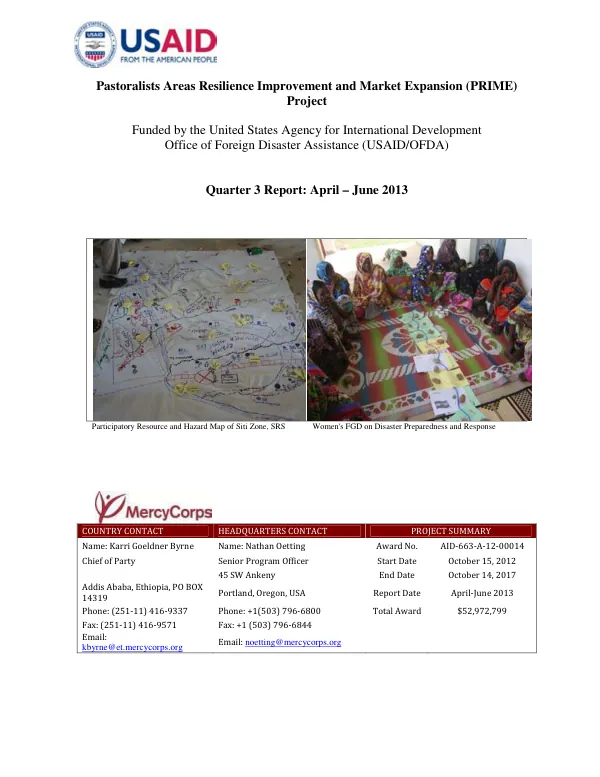
Pastoralist Areas Resilience Improvement through Market Expansion (PRIME) Project Quarter 15 Report
Sign inMERCY CORPS INTERNATIONAL
Pastoralist Areas Resilience Improvement through Market Expansion (PRIME) Project Quarter 15 Report
The Pastoralist Areas Resilience Improvement through Market Expansion (PRIME) Project is a five-year initiative funded by the United States Agency for International Development (USAID) to support resilience among pastoralist communities in Ethiopia.
2016 · 70 pages
Sign in to readA free account is required to download.
Abstract
The project aims to enhance prospects for long-term development in the dryland landscape where the pastoralist livelihood system prevails. PRIME is designed to be transformative, innovative, and achieve scale through market-driven approaches to livestock production and livelihood diversification that support dryland communities to adapt to a changing climate. The project has five major objectives, including improved productivity and competitiveness of livestock and livestock products, enhanced pastoralists' adaptation to climate change, strengthened alternative livelihoods for households transitioning out of pastoralism, ensured enhanced innovation, learning, and knowledge management, and improved nutritional status of targeted households. The project works to meet these objectives through various activities, including the development of live animals trade, meat, dairy, and livestock inputs value chains, and the implementation of emergency market activities to prevent drought negative effects on livestock and livestock marketing. During Quarter 15, PRIME continued to support activities and processes under the natural resource management and climate change adaptation components of the project. The NRM activities focused on ensuring the continuity of the rangeland councils' role, supporting rangeland restoration activities, and facilitating hay making trainings to encourage communities to harvest and store surplus grass for the next dry season. The accomplishments under the NRM activities this quarter include supporting regular rangeland councils meetings in ten rangeland systems, facilitating the construction and rehabilitation of two important water points, and clearing and restoring 267ha and 1498ha of rangeland, respectively. The CCA component of the project also achieved significant milestones during the reporting period, including training on Basic Data Collection and Dissemination Techniques for Kebele Early Warning Committee Members in Afar, facilitating the process of Participatory Scenario planning (PSP) workshop in Erer, Siti zone, and providing continuous support for the local SAA groups' discussions and meetings in Afar and Southern cluster. In addition to these activities, PRIME also implemented various interventions to support households transitioning out of pastoralism, including cash transfer and financial literacy training for drought-stricken areas of Afar Zone 3 and Siti zone. The cash transfer intervention targeted 5000 pastoralists and households transitioning out of pastoralism, with households in the lowest wealth quartile being the primary targets. PRIME partnered with Afar MFI and Somali MFI to implement this activity in both regions, with all targeted households opening bank accounts, attending financial literacy and nutrition training, and receiving cash through their bank accounts. PRIME also supported the expansion of Somali MFI branches, with seven new branches coming into function, resulting in improved performance and an increase in the number of savers and borrowers. Furthermore, the project established VSLA groups through a private service provider, with 10 new field agents deployed to fieldwork, 158 additional new groups established, and a total of 2441 members, increasing the total number of groups formed and total VSLA members to 586 and 10740, respectively. The total amount of savings reached ETB 3,806,749 ($177,000) with a total loan outstanding balance of ETB 2,052,050 ($95,500). The project also implemented literacy training in five woredas of Afar Zone 3, with 1086 beneficiaries involved in IFAL adult literacy training, including 711 male and 375 female. The numbers of beneficiaries involved in literacy training are expected to increase in the coming quarters.
Related documents