USAID DEC
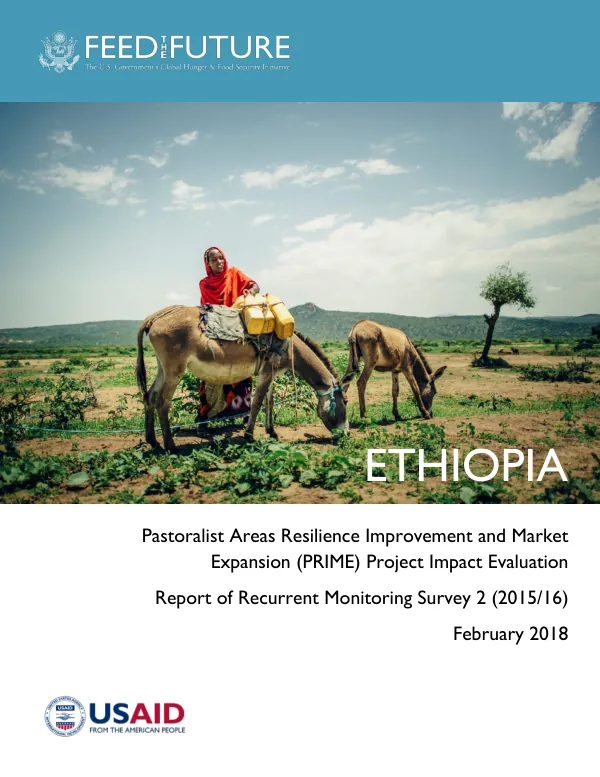
Pastoralist Areas Resilience Improvement through Market Expansion (PRIME) Project Quarter 14 Report
Sign inCARE
Pastoralist Areas Resilience Improvement through Market Expansion (PRIME) Project Quarter 14 Report
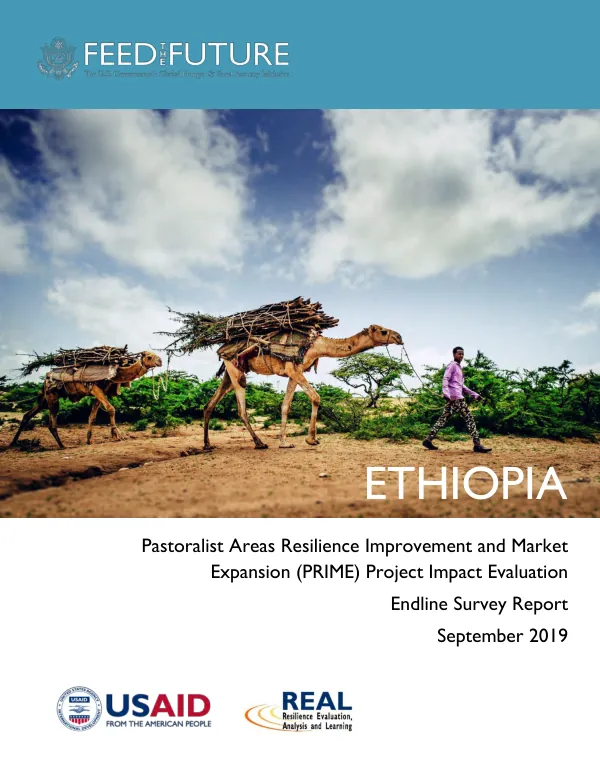
The Pastoralist Areas Resilience Improvement through Market Expansion (PRIME) Project is a five-year initiative funded by the United States Agency for International Development (USAID) to support resilience among pastoralist communities in Ethiopia.
2016 · 76 pages
Sign in to readA free account is required to download.
Abstract
The project aims to enhance prospects for long-term development in Ethiopia's dryland landscape, where the pastoralist livelihood system prevails. PRIME is designed to be transformative, innovative, and achieve scale through market-driven approaches to livestock production and livelihood diversification that support dryland communities to adapt to a changing climate. The project focuses on five major objectives, including improved productivity and competitiveness of livestock and livestock products, enhanced pastoralists' adaptation to climate change, strengthened alternative livelihoods for households transitioning out of pastoralism, ensured enhanced innovation, learning, and knowledge management, and improved nutritional status of targeted households. To achieve these objectives, PRIME works to meet the needs of pastoralist communities through various interventions, including the development of the live animals trade, meat, dairy, and livestock inputs value chains. During Quarter 14, PRIME implemented numerous trainings focused on handling and using over-the-counter animal health products, production and conservation of feed and fodder, handling and marketing of milk and meat products, benefiting 162 people. The number of enterprises in the value chains that were offered and obtained business development and marketing assistance increased by 30 for a total of 330. PRIME also developed and started implementing extraordinary activities focused on preventing the negative effects of drought on livestock and livestock marketing, including destocking and veterinarian vouchers interventions. PRIME's IR 2 focuses on enhancing pastoralists' adaptation to climate change by improving availability and access to climate information services, supporting strengthening of early warning systems, and the capacity of local institutions for improved resource governance and management practices. During Quarter 14, PRIME successfully implemented rangeland restoration activities over an estimated area of 1,164 hectares, and the rehabilitation and development of water points, including rainwater harvesting ponds, underground water storage tanks, and the rehabilitation of traditional wells. PRIME continues to address the underlying causes of vulnerability to climate variability and change in Afar and Somali regions and in Guji and Borena zones by successfully implementing CARE's proven Social Analysis and Action methodology to empower communities to explore and challenge the social norms, beliefs, and practices that shape their lives and livelihoods. In the reporting period, the focus has been on equitable gender norms as well as community support for fodder production and hay making, herd management, and savings culture. PRIME has also promoted the production and conservation of improved fodder crops in Afar, Borena, and Guji by facilitating practical and field-based trainings on improved agronomic practices and fodder management techniques. In addition to trainings, model agro-pastoralists interested in growing fodder were given improved fodder seeds in cost-sharing arrangements. The institutionalization of the participatory scenario planning approach by the respective DPPB in Borena and Liben zones encouraged integration of PSP into community livelihood adaptation and local government development planning. PRIME's interventions to enhance employment and entrepreneurship to create jobs for people transitioning out of pastoralism (TOPs) are paying off. During this quarter, PRIME supported the creation of 117 new jobs and helped 172 TOPs to obtain jobs in the labor market. Simultaneously, PRIME is building the capacity of TVETs and providing scholarship opportunities for TOPs to acquire skill training to become more easily employable or start their own business. The enterprises that are hiring TOPs include JESH, Somali MFI, Rays MFI, Afar MFI, Barwako dairy processing, AGP poultry, PVPs, and agricultural input suppliers, among others. Additional 466 job seekers (TOPs) are registered on the HelloJobs System, increasing the total number of registered job seekers in the HelloJobs database to 3,328 (2,769 male and 559 female). The profile of these job seekers is now available for employers to access from the system free of charge should they want to hire these job seekers.