DAI
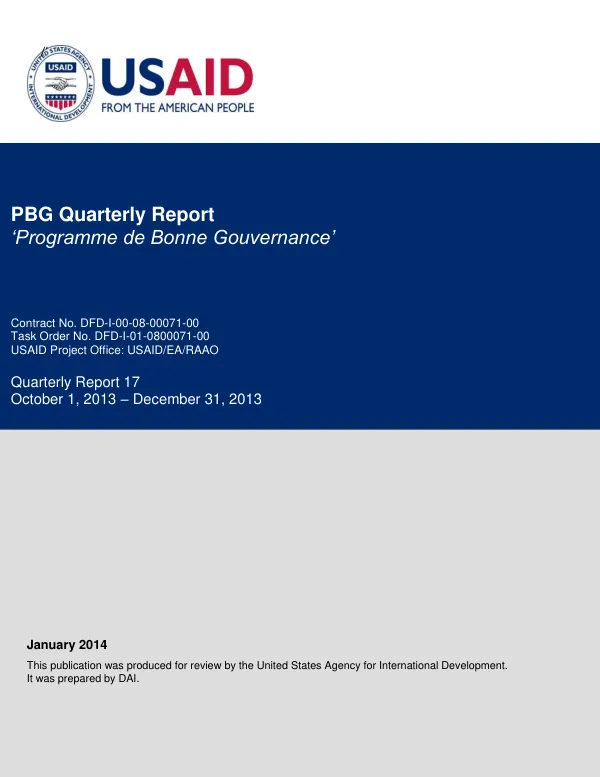
PBG – FY 2014 Quarterly Report 17
The Programme de Bonne Gouvernance (PBG) is a five-year program aimed at improving management capacity and accountability of select legislatures and local governments in the Democratic Republic of Congo.
2014 · 179 pages
Sign in to readA free account is required to download.
Abstract
The program operates in five areas of the country, working closely with civil society organizations, parliamentary institutions, and public institutions. The program's purpose is to strengthen capacities in the fight against corruption, improve management of public resources, and enhance citizen participation in governance. The program's activities are divided into three main components: IR1, IR2, and IR3. IR1 focuses on training civil society organizations and government authorities on human rights and anti-corruption practices. During the first quarter of Year 5 (FY 2014), IR1 achieved several milestones, including training 669 members of civil society organizations, sponsoring 4 interactions between civil society organizations and government authorities, and conducting training on human rights and women's involvement in the anti-corruption fight. IR2 focuses on strengthening the capacity of parliamentary institutions at the central and provincial level. During the first quarter of Year 5, IR2 achieved several milestones, including training or providing technical assistance to 227 staff and members of Parliament, promoting 28 public audiences conducted with provincial MPs, and providing assistance for a workshop on triangulation and validation of proposed edicts. IR3 focuses on improving the management capacity of local governments. During the first quarter of Year 5, IR3 achieved several milestones, including training a total of 453 local government employees, launching the implementation phase of the database of taxpayers in Bukavu, and completing environmental impact studies for direct assistance activities for the ETDs of Kadutu and Ngweshe. The political background in the Democratic Republic of Congo during the first quarter of Year 5 was marked by several significant events. The national consultations ended on October 5th, and President Kabila delivered a speech indicating that he would call on both houses of Parliament to reflect on the recommendations issued during this event. The President also promulgated the Organic Law n° 13/026 of 15 October 2013 on the organization and functioning of the Constitutional Court, which includes presidential and legislative election disputes. The Prime Minister submitted the draft state budget for the 2014 fiscal year on November 22nd, which is pending presentation to the plenary of the National Assembly. The budget details estimated revenues and expenses at 7,611.8 billion Congolese Francs, an increase of 4.9% over the 2013 budget levels. The M23 armed insurgency surrendered on November 5th, and the government and MONUSCO called on all armed groups to voluntarily disarm and integrate into the process of Disarmament, Demobilization, and Reintegration (DDR) into the regular army. The Law on programming the implementation of the reform of the Congolese National Police for the period 2014-2017 was passed on December 5th, which will facilitate supervision and provide guidance for actions to be implemented during the period. The Minister of the Interior, Security, and Decentralization Customary Affairs met with Ambassadors and development partners on December 9th to present the status of ongoing reforms in his sector, including decentralization reform. The Office of the National Assembly and the Senate received a visit from the Prime Minister on December 10th, who asked them to submit within forty-eight hours the bill providing for provisional credit. The document was examined and adopted by the National Assembly on December 12th, which authorized provisional appropriations in the amount of 604.9 billion Congolese francs (657.5 million U.S. dollars) to enable the Government to implement expenditures for January 1st-31st, 2014 pending the vote on the draft Finance Bill tabled on November 22nd. The National Assembly conducted a plenary session on Sunday, December 15th, during which nine alternates were approved, and a bill was adopted laying down detailed implementation of regulations concerning women's rights and gender equality. The September regular session was closed, and the National Assembly adjourned until the next session.
Related documents