USAID DEC
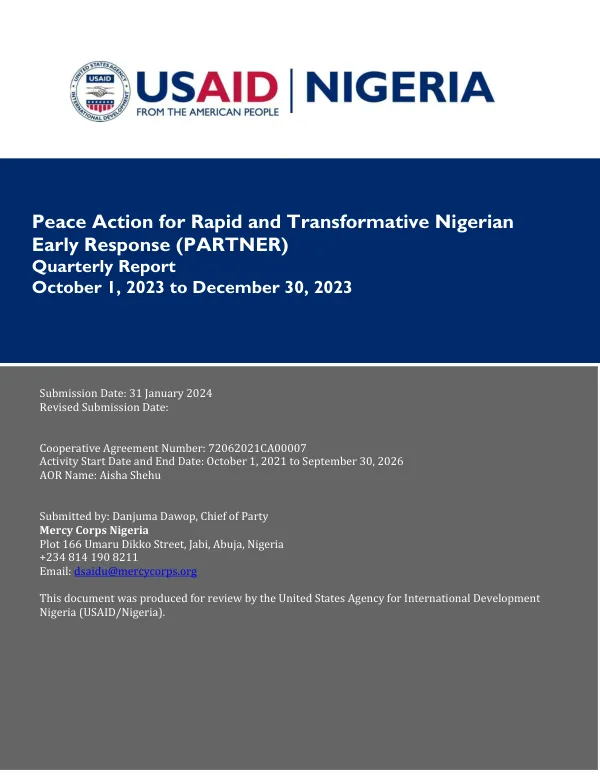
Peace Action for Rapid and Transformative Nigerian Early Response (PARTNER) FY24 Q1 Report
Sign inMERCY CORPS INTERNATIONAL
Peace Action for Rapid and Transformative Nigerian Early Response (PARTNER) FY24 Q1 Report
Peace Action for Rapid and Transformative Nigerian Early Response (PARTNER) is a 60-month, $7.8M Cooperative Agreement with the United States Agency for International Development (USAID) beginning October 1, 2021, and ending September 30, 2026.
2024 · 37 pages
Sign in to readA free account is required to download.
Abstract
The goal of PARTNER is to increase the effectiveness, local ownership, and sustainability of an inclusive Early Warning Early Response (EWER) system for improved violence prevention in Nigeria. The Activity pursues a bold approach to promote collaboration across local, international, government, non-government, community, state, and security stakeholders to achieve its goal. Mercy Corps is leading Activities in a mentorship capacity in Years 1 and 2, working closely with Nigerian organization, West Africa Network for Peacebuilding (WANEP). WANEP will assume leadership beginning in Year 3 through either a transition award or by Mercy Corps transitioning further responsibilities to WANEP. PARTNER will achieve its goal through three objectives: 1) Key stakeholders work together to create and sustain conflict EWER systems to foster peace and tolerance in communities and mitigate conflict and criminality in areas currently affected or at risk of violent conflict; 2) Engage a diverse set of key stakeholders towards community-based efforts to promote communication, dispute resolution, dialogue, and advocacy for peace and reconciliation; and 3) Key stakeholders work together to enhance trust and confidence among community members and between communities and security forces through social cohesion initiatives. To maximize strategic use of funds, PARTNER employs tiered geographic targeting. PPBA and KSPC will coordinate with WANEP to lead deep engagements. Growth and expansion in Benue, Katsina, Kano, and Kogi will capitalize on gains made through the Mercy Corps-led, USAID-funded Community Initiatives to Promote Peace (CIPP) Activity. PARTNER will aim to strengthen systems from the bottom up in states such as Niger, Nasarawa, and Zamfara. IPCR and Mercy Corps will lead rapid, rigorous testing and learning by implementing pilot activities with low-cost impact valuations embedded in the MEL system. This approach aims to identify and scale the most effective EWER components. Conflict Sensitivity and Do-No-Harm (DNH) will inform analysis and start-up, participant selection, engagement, and constant adaptation to ensure resilient implementation and a shock-informed and responsive EWER system. Moving beyond immediate peace outcomes, the true success of PARTNER rests on its ability to strengthen and sustain local capacity and ownership amongst both NGO and government partners. Mercy Corps aims to hand over successive responsibility to WANEP through a jointly owned, systematic approach to capacity strengthening and transition. Mercy Corps, WANEP, and USAID will track progress against the following stages: joint organizational capacity assessment, transition planning, implementation of capacity strengthening (including mentorship and accompaniment), transition of responsibility, and the assumption of primary program leadership by WANEP. The PARTNER consortium members seek to advance sustainability and national-level impact through a multi-pronged approach. An Advisory Council, comprising key government, civil society, advocacy, business, and other influential stakeholders, will guide the effective implementation. It will also ensure buy-in at the highest levels and support the creation of a detailed sustainability plan. To enhance the probability of achieving enduring national-level impact, PARTNER will utilize systematic analysis and adaptive goal setting. This involves scenario planning and contingency setting informed by political changes. The comprehensive strategy aims to identify windows of opportunity and consolidate gains through a suite of approaches, including achieving quick wins and establishing transparent and frequent communication with stakeholders. PARTNER will employ a range of technical approaches to ensure broad inclusion in and ownership of the EWER system and other activities amongst people across gender, age, and ability. PARTNER will also include diverse ethnic and religious groups. Traditional, religious, government, and security authorities from the local to national level will increase their confidence and skills in EWER and will embrace gender-sensitive indicators, reporting mechanisms, and response. The geographic coverage of PARTNER includes Benue, Plateau, Kaduna, Katsina, Kano, Kogi, Niger, Nasarawa, and Zamfara states in Nigeria. The reporting period for this report is October 1, 2023, to December 30, 2023.