USAID DEC
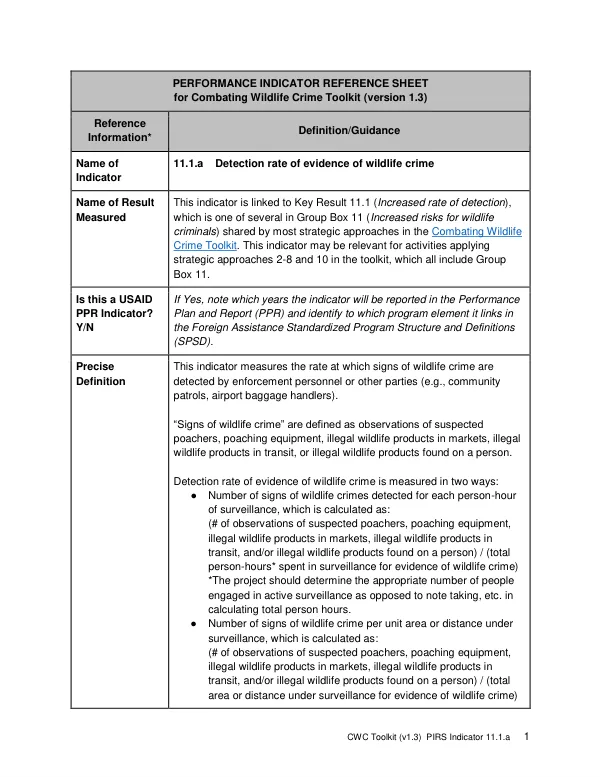
PERFORMANCE INDICATOR REFERENCE SHEET for Combating Wildlife Crime Toolkit (version 1.3)
Sign inUSAID
PERFORMANCE INDICATOR REFERENCE SHEET for Combating Wildlife Crime Toolkit (version 1.3)
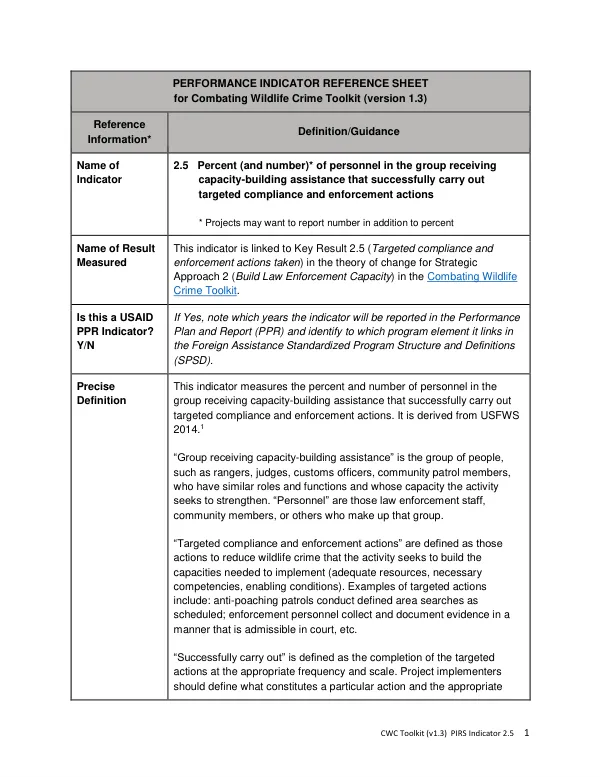
The Combating Wildlife Crime Toolkit (version 1.3) outlines a performance indicator, PIRS Indicator 2.5, which measures the percent and number of personnel in a group receiving capacity-building assistance that successfully carry out targeted compliance and enforcement actions.
2017 · 5 pages
Sign in to readA free account is required to download.
Abstract
This indicator is linked to Key Result 2.5 in the theory of change for Strategic Approach 2 (Build Law Enforcement Capacity) in the Combating Wildlife Crime Toolkit. The indicator measures the extent to which the group receiving capacity-building assistance has taken a desired targeted compliance and enforcement action to reduce wildlife crime at the appropriate frequency and scale. It is derived from the USFWS 2014.1 "Standard Measures of Effectiveness and Threats for Wildlife Conservation in Central Africa: Guidance for USFWS Applicants." The indicator is measured in two ways: the number of personnel in the identified audience who successfully carry out the targeted actions, and the percent of personnel in the group receiving capacity-building assistance who successfully carry out the targeted actions. The indicator is disaggregated by step in the enforcement-prosecution chain that the targeted actions contribute to, position of enforcement personnel, and sex of enforcement personnel. The rationale for the indicator is to measure the extent to which the group receiving capacity-building assistance has taken a desired targeted compliance and enforcement action to reduce wildlife crime at the appropriate frequency and scale. Data sources for the indicator may include assessments, surveys, and/or records from government agencies, implementing partners, and/or community-based groups. The design of data collection instruments and protocols for data collection and analysis should be informed by robust statistical methodologies and best practices in the field. The data is collected by observation of actions and/or by reviewing the government agency's, implementing partners', or community-based groups' records. The indicator is reported annually, and the baseline timeframe for the indicator is an initial baseline measure that must be established. The rationale for targets is not specified, but the indicator may be relevant when the associated result appears in a customized chain. The dates of data quality assessments (DQA) and the name of the reviewer must be indicated, as well as the date of future planned DQAs. Known data limitations include validity issues due to the possibility of not being able to attribute actions to the preceding capacity-building activities, and reliability, timeliness, precision, and integrity issues are not known.