USAID
Final Report: Detection Rate of Evidence of Wildlife Crime
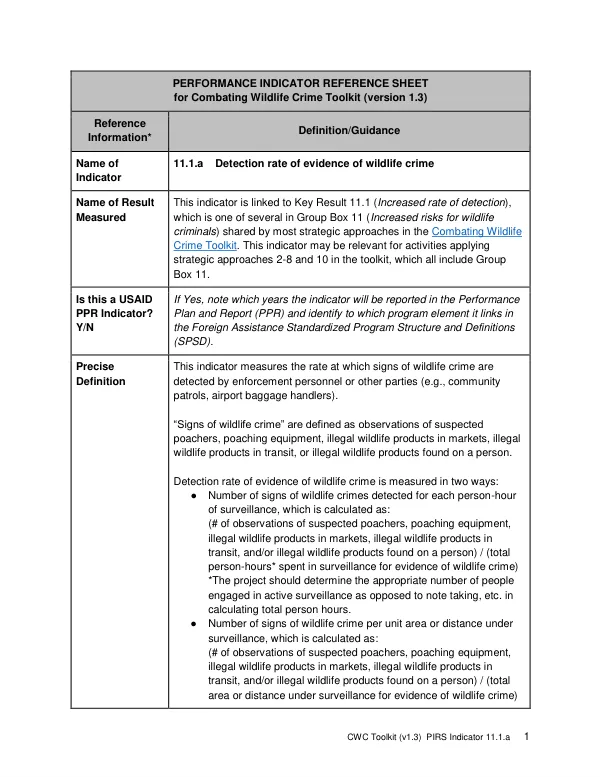
The Combating Wildlife Crime Toolkit (CWC Toolkit) version 1.3 includes a performance indicator reference sheet for PIRS Indicator 11.1.a, which measures the detection rate of evidence of wildlife crime.
2017 · 7 pages
Sign in to readA free account is required to download.
Abstract
This indicator is linked to Key Result 11.1, which is part of Group Box 11, "Increased risks for wildlife criminals," shared by most strategic approaches in the CWC Toolkit. The indicator measures the rate at which signs of wildlife crime are detected by enforcement personnel or other parties, such as community patrols or airport baggage handlers. Signs of wildlife crime include observations of suspected poachers, poaching equipment, illegal wildlife products in markets, illegal wildlife products in transit, or illegal wildlife products found on a person. The detection rate is measured in two ways: the number of signs of wildlife crimes detected for each person-hour of surveillance and the number of signs of wildlife crime per unit area or distance under surveillance. The CWC Toolkit recommends calculating both measures to account for changes in time spent in surveillance and changes in the area or distance under surveillance when interpreting changes in the number of detections of evidence of wildlife crime. Detection rate is expected to increase with instances of wildlife crime and with enforcement skill, indicating increased enforcement skill and/or increased crime. The indicator should be measured in conjunction with other factors associated with increased risks for wildlife criminals, including increased probability of arrest, increased probability of prosecution, increased probability of conviction, and increased probability of appropriate penalty/deterrent applied to conviction. Disaggregation of data by type of wildlife crime, age of evidence, and characteristics of the suspect, such as nationality, community affiliation, sex, and age, may be useful. The CWC Toolkit provides guidance on determining who collects what kinds of data, who has authority and access to the data, and how crime data is collected and categorized locally. Implementers should determine the most feasible method for tracking individual cases in subsequent steps of the enforcement-prosecution chain. The design of data collection instruments and protocols for data collection and analysis should be informed by robust statistical methodologies and best practices in the field. For USAID-funded projects, implementers should respect data ownership rights and data sensitivity issues. All data collected should be archived and made available through the Development Data Library (DDL) per ADS Chapter 579, USAID Development Data. The frequency at which data are measured will depend on the type of evidence, available survey techniques, and available records, and data should be reported at least annually.