USAID
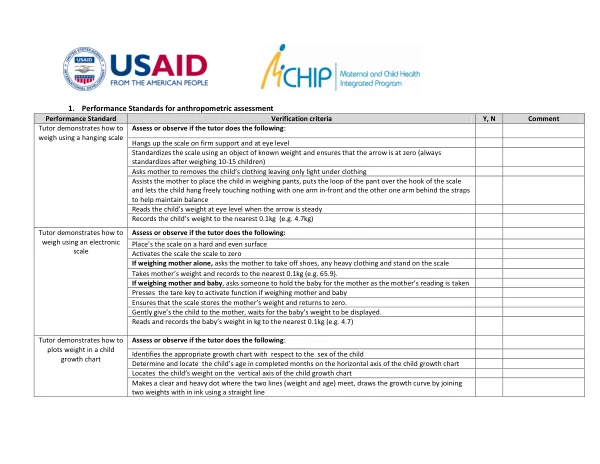
Performance Standards for Anthropometric Assessment
Anthropometric assessment is a critical component of clinical nutrition evaluation, enabling healthcare professionals to monitor growth and nutritional status in children and adults.
32 pages
Sign in to readA free account is required to download.
Abstract
The World Health Organization (WHO) has established standardized procedures for measuring weight, height, and mid-upper arm circumference (MUAC) to assess nutritional status. Weight measurement is a fundamental aspect of anthropometric assessment. The WHO recommends using a hanging scale for children under 2 years and an electronic scale for children over 2 years and adults. When using a hanging scale, the tutor must ensure the scale is hung on a firm support at eye level and standardized using an object of known weight. The child's clothing should be minimal, and the child should be placed in weighing pants with the loop over the hook of the scale. The tutor must read the weight at eye level when the arrow is steady and record it to the nearest 0.1 kg. When using an electronic scale, the tutor must place the scale on a hard and even surface, activate it to zero, and ensure it is calibrated. For adults, the tutor must ask the individual to remove shoes and heavy clothing and stand on the scale. The tutor must take the adult's weight and record it to the nearest 0.1 kg. For children, the tutor must ask someone to hold the baby while the mother's weight is taken, press the tare key to activate the function, and ensure the scale stores the mother's weight and returns to zero. The tutor must then gently give the child to the mother, wait for the baby's weight to be displayed, read and record the baby's weight to the nearest 0.1 kg. Anthropometric indices, such as weight for height (WFH), height for age (HFA), and weight for age (WFA), are used to assess nutritional status. The WFH index is used to assess wasting, while the HFA index is used to assess stunting. The WFA index is used to assess underweight. Body Mass Index (BMI) is used to assess body thinness in adults above 18 years. The WHO has established cut-offs for BMI to categorize nutritional status. A BMI of less than 16.0 kg/m2 indicates severe malnutrition, while a BMI of 16.0 to less than 18.5 kg/m2 indicates moderate malnutrition. A BMI of 18.5 to less than 25.0 kg/m2 indicates normal nutritional status, while a BMI of 25.0 to less than 30.0 kg/m2 indicates overweight, and a BMI of 30.0 kg/m2 or greater indicates obesity. Clinical nutrition assessment involves recognizing signs and symptoms of wasting, kwashiorkor, and micronutrient deficiencies. The tutor must provide at least three signs/symptoms of marasmus, including loss of fat on the face, loose skin around the buttocks, and easy-to-see bones. The tutor must also provide at least three signs/symptoms of kwashiorkor, including a swollen face, pitting oedema of both feet, and skin lesions. The tutor must demonstrate how to assess for bilateral pitting oedema, which is a characteristic sign of kwashiorkor. The tutor must apply thumb pressure on both feet for three seconds and check the upper limbs, hands, and face. The tutor must explain the grades of bilateral pitting oedema severity, including absent, mild, moderate, and severe. The tutor must also explain how to assess for dehydration in children with severe acute malnutrition (SAM). The tutor must examine for and explain skin peeling and degree of severity, including mild, moderate, and severe.