ERNST & YOUNG
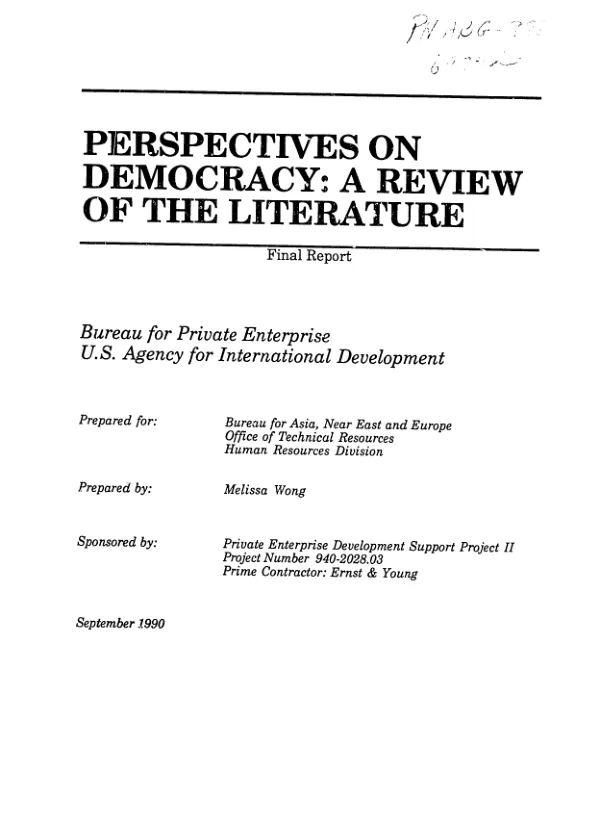
Perspectives on democracy : a review of the literature
Scholars have long debated the question which comes first -- open markets or open societies -- and have offered a variety of opinions on the relationship between economic growth and democratic development.
Wong, Melissa · 1990
Sign in to readA free account is required to download.
Abstract
This paper reviews major themes and findings in recent literature on this subject and on related aspects of democracy. Section I finds that recent literature confirms the generally positive relationship between economic development and democracy, although there are significant exceptions, e.g., Hungary, where the recent push towards democracy has been driven by poor rather than prosperous economic conditions. Section II explores these exceptions by examining what scholars are saying about the social, educational, political, and cultural factors that foster or constrain the development of stable democratic systems. All agree on one thing: in extremely poor countries the prospects for democracy are dim. Literature on how and why democracies rise and fall is examined in Section III. Prospects seem best when the transition to democracy is gradual and peaceful and when participation precedes competition; foreign support for liberalization and economic development can prove helpful here. The final section reviews major measures of democracy (Bollen"s POLDEM Scale, Coppedge/Reinicke Polyarchy Scale, and Gastil"s Comparative Survey of Freedom), concluding that while democracy cannot be measured precisely it does have recognizable characteristics, notably, free and fair elections and significant political and civil freedoms.