FLORIDA INTERNATIONAL UNIVERSITY
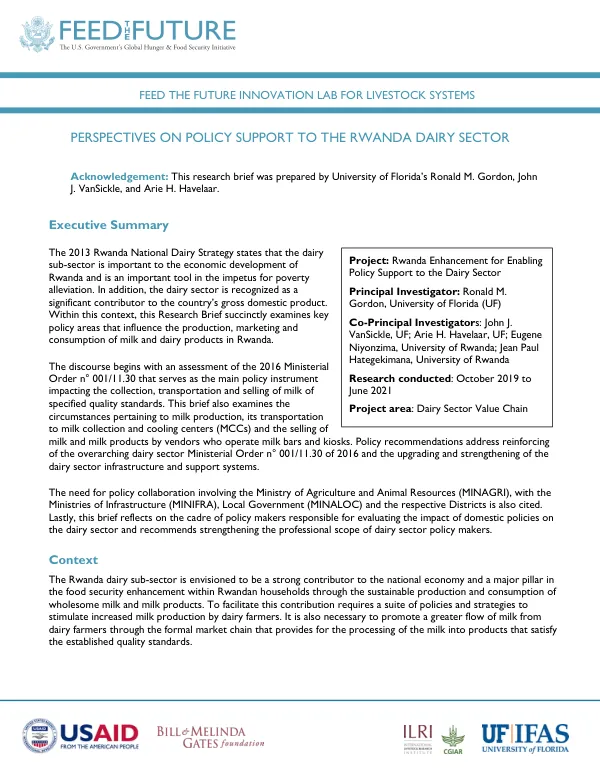
Perspectives on Policy Support to the Rwanda Dairy Sector
The Rwanda dairy sub-sector is envisioned to be a strong contributor to the national economy and a major pillar in the food security enhancement within Rwandan households through the sustainable production and consumption of wholesome milk and milk products.
2021 · 4 pages
Sign in to readA free account is required to download.
Abstract
To facilitate this contribution, a suite of policies and strategies is required to stimulate increased milk production by dairy farmers and promote a greater flow of milk from dairy farmers through the formal market chain that provides for the processing of the milk into products that satisfy established quality standards. The 2016 Ministerial Order n° 001/11.30 is intended to be the main policy instrument impacting the collection, transportation, and selling of milk of specified quality standards. However, it seems not to be functioning well, with several lapses reported and the sale of milk on the informal market competing strongly with milk distribution through the formal market for processed milk and milk products. The Ministerial Order is intended to promote the flow of milk of wholesome quality to consumers, but there is substantial non-compliance with this Order that results in a large volume of unprocessed milk being sold through the informal market. Dairy farmers cited the need for technical assistance to catalyze improvements in dairy production and milk output. Among other things, the technical assistance requirements cited were in the areas of animal husbandry, modern dairy farming techniques, the cultivation of improved grasses for feed, improved access to water, and the construction of cowsheds. Access to more comprehensive and less costly veterinary services as well as the ability to conduct milk quality tests were also identified as critical for dairy farmers to be able to produce increased and better-quality milk output. The disease burden from the consumption of dairy products was evaluated by extracting data for Rwanda from the World Health Organization's Global Burden of Foodborne Disease study and collecting additional data to attribute the burden of dairy to specific products, like raw milk, through a Structured Expert Elicitation study. Experts participating in the study were from Rwanda or had a working knowledge of the Rwanda dairy value chain and related public health impacts. The study found that 57,500 illnesses occurred annually in Rwanda owing to consumption of dairy products, causing 55 deaths and a loss of 3,870 Disability Adjusted Life Years (DALYs) and causing a cost-of-illness of US$3.2 million. Recommendations were made to reinforce the regulations in the Ministerial Order n° 001/11.30 of 10/02/2016 through random monitoring and evaluation visits to the respective constituents of the milk value chain and a more diligent monitoring of the adherence to the Order. Collaboration with local governments in the respective Districts regarding the monitoring of adherence to the Order was also recommended. Additionally, a long-term development plan was suggested to upgrade farm/feeder roads in collaboration with the Ministry of Infrastructure (MINIFRA) to improve the efficiency of milk transportation and reduce the time it takes for milk to be transported from dairy farmers to milk collection and cooling centers (MCCs).
Related documents
Documents in this collection
 2021
2021USAID DEC
Effectiveness Assessment for Expanding Small-Scale, Off-Grid Renewable Energy Lending in Ghana, Rwanda, and Uganda: Climate Economic Analysis for Development, Investment, and Resilience (CEADIR)
Open record 2021
2021USAID DEC