USAID DEC
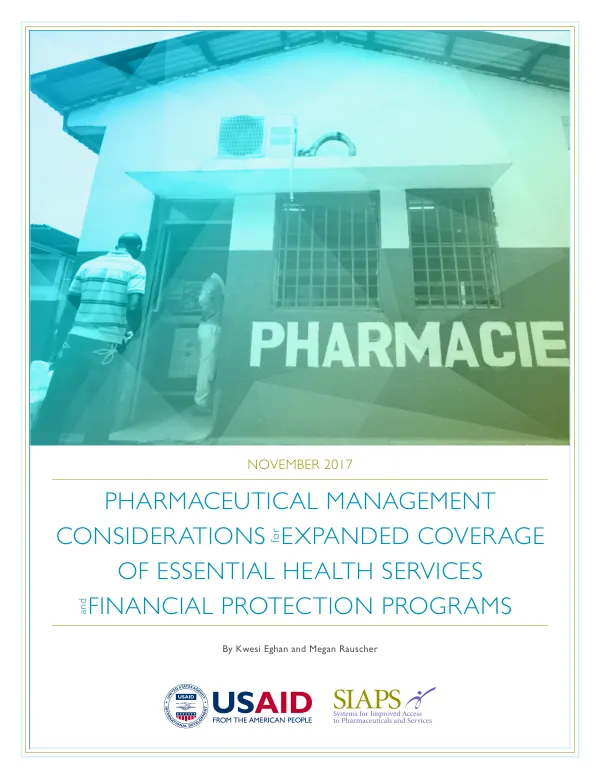
Pharmaceutical Management Considerations for Expanded Coverage of Essential Health Services and Financial Protection Programs
Sign inUNITED NATIONS
Pharmaceutical Management Considerations for Expanded Coverage of Essential Health Services and Financial Protection Programs
Pharmaceutical management plays a critical role in achieving Universal Health Coverage (UHC) objectives.
2017 · 22 pages
Sign in to readA free account is required to download.
Abstract
Despite the expansion of financial protection programs, more than one billion people globally still lack access to basic health care, and out-of-pocket payments are very high in many countries. An estimated 150 million people suffer financial catastrophe each year due to health care-related expenses. The severe consequences of catastrophic health expenses on individuals, communities, and countries have generated significant discussions on resource mobilization to increase health system financing. Pharmaceutical products, other health technologies, and related services are vital to achieving UHC objectives because they are essential to high-quality health service delivery. Pharmaceuticals contribute significantly to household health expenditures and account for 45% to 57% of out-of-pocket payments. Global spending on medicines is forecasted to reach USD 1.2 trillion in 2017 and account for up to 67% of total health expenditures in some countries. Medicines are also a primary driver of inefficiency in the health systems due to poor pharmaceutical management practices, such as faulty selection and quantification, poor procurement and distribution practices, underuse of generic medicines, use of substandard and counterfeit medicines, and inappropriate medicine use. Improving pharmaceutical management practices and strengthening pharmaceutical systems to ensure the availability, affordability, and appropriate use of pharmaceutical products is imperative for achieving UHC. The substantial contributions that quality-assured pharmaceutical products make to health and well-being cannot be underestimated and warrant an explicit focus on and investment in pharmaceutical management and systems strengthening in the efforts to expand health services coverage and financial protection. Pharmaceutical systems and pharmaceutical systems strengthening are critical components of the health system, and ensuring equitable access to quality-assured medicines and their appropriate use is a core function of the health system. The World Health Organization (WHO) defines three primary UHC objectives: increasing the availability of a wider range of high-quality health services to entire populations, reducing out-of-pocket expenses for health care, and ensuring that people can access and use health services when and where they need them. The UN adoption of the Sustainable Development Goals (SDGs) in 2015 signaled a strong commitment of member countries to the expanded access to essential health service agenda and definitively recognized the critical role of medicines in achieving UHC. The SDGs call for countries to achieve universal health coverage, including financial risk protection, access to quality essential health care services, and access to safe, effective, quality, and affordable essential medicines and vaccines for all. Countries can choose approaches to adopt in providing financial access to medicines and protection for expanded health services to their populations. They should consider context-specific interventions that address challenges and sustainably strengthen their pharmaceutical systems to provide much-needed health services. Using appropriate metrics at the country level to track progress and ensure that strengthening efforts are effective will be essential for countries working toward extending coverage for essential health services and financial access to medicines.
Related documents