ANOVA HEALTH INSTITUTE
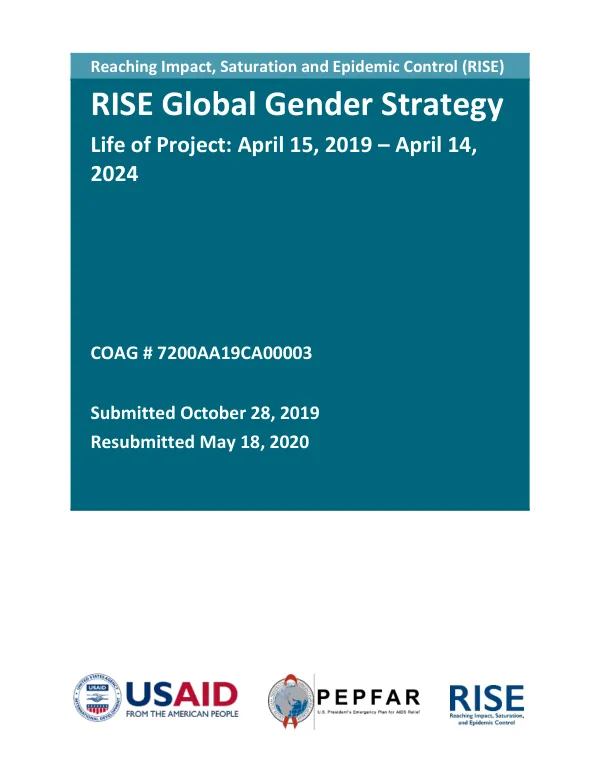
Reaching Impact, Saturation and Epidemic Control (RISE) Global Gender Strategy
The RISE Global Gender Strategy is a 5-year project funded by the U.S.
2019 · 44 pages
Sign in to readA free account is required to download.
Abstract
President's Emergency Plan for AIDS Relief (PEPFAR) and the U.S. Agency for International Development (USAID). The project aims to achieve epidemic control by 2024, with stronger local partners capable of managing and achieving results through sustainable, self-reliant, and resilient health systems. RISE's contributions to this work will lead to fewer new HIV infections, decreased HIV-related morbidity and mortality, and increased quality of life for people living with HIV. The strategy was developed in collaboration with several organizations, including Jhpiego, ICAP at Columbia University, Management Sciences for Health, Anova Health Institute, BAO Systems, JHU Center for Public Health and Human Rights, and Mann Global Health (MGH). The document provides overall guidance for RISE country programs, partners, and stakeholders, and presents evidence-based approaches that should be prioritized by RISE country programs as they consider gender-focused programming. The strategy highlights the importance of addressing gender-related barriers to HIV prevention, care, and treatment. Research has shown that gender norms and inequalities influence HIV and AIDS prevention, care, and treatment in various ways, including limiting women's ability to negotiate safer sex, promoting aggression and HIV risk behaviors, and limiting access to education and resources. The strategy emphasizes the need to address these barriers through evidence-based interventions and activities, including promoting gender-sensitive, key population-friendly services, engaging men as clients, partners, and agents of change, and addressing violence and coercion. Key facts highlighted in the strategy include the disproportionate impact of HIV on adolescent girls and young women in sub-Saharan Africa, the higher proportion of men having sex with non-regular partners compared to women, and the lower likelihood of men accessing HIV services compared to women. The strategy also notes that globally, one in three women experiences gender-based violence in her lifetime, and women experiencing intimate partner violence are 1.28-2 times as likely to be HIV-positive. The strategy provides guidance on specific measures for ongoing monitoring, evaluation, learning, and adaptation of gender integration approaches and activities. It also outlines the required and custom gender indicators that will be used to track progress and evaluate the effectiveness of the strategy. The document includes several annexes, including additional definitions, gender analysis guidance, and gender integration resources. Overall, the RISE Global Gender Strategy aims to promote gender-equitable and gender-transformative solutions to prevent and mitigate the HIV epidemic, and to support local HIV stakeholders in implementing evidence-based strategies to achieve epidemic control by 2024.
Related documents