USAID. MISSION TO PHILIPPINES
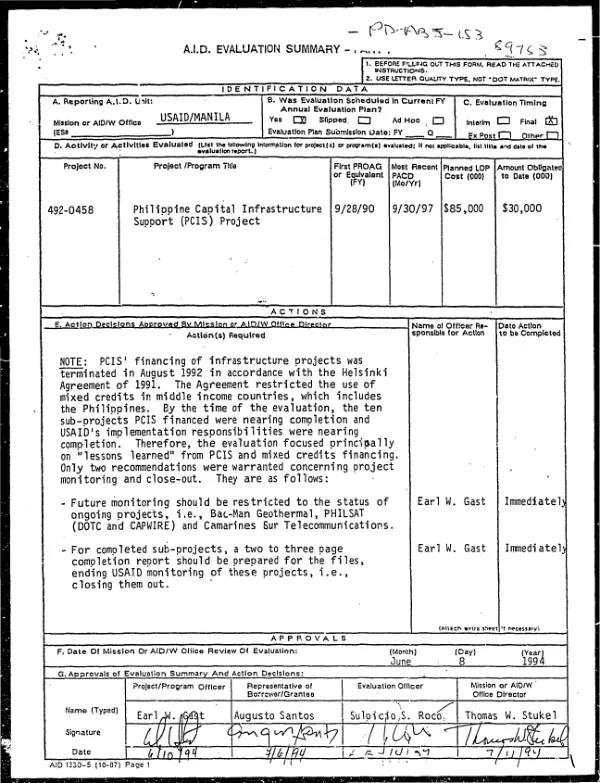
Philippine capital infrastructure support (PCIS) project
Summarizes final evaluation (XD-ABJ-153-A) of a project to establish, in cooperation with the U.S.
1994
Sign in to readA free account is required to download.
Abstract
Export-Import Bank (EXIM), a Concessional Financing Facility (CFF) for priority infrastructure projects in the Philippines. Planned originally as a 7-year effort, the project, which began in 9/90, was terminated prematurely in 8/92 as a consequence of the 1991 Helsinki Agreement, which limited the use of mixed credits in middle-income countries. The project was flawed from the start by political factors, growing as it did out of the U.S. Government"s desire to counter other countries" use of concessional financing to promote exports. The Mission was given less than 3 months to submit a Project Paper (PP) for what was universally recognized as an unusually complex and innovative undertaking requiring resolution of numerous design and policy issues. The Philippine implementing agency, the National Economic and Development Agency (NEDA), had virtually no input into the design process. The resulting PP was fundamentally flawed; many of its key assumptions proved unfounded, particularly the estimated pace of implementation, and it provided little practical guidance for project start-up and implementation. Due to the neglect of important procedural issues during project design, implementation was a nightmare; the basic agreement between EXIM and the Philippine Department of Finance for the CFF took almost a year to negotiate, and SP identification and approval lagged far behind expectations. These difficulties were compounded by disagreement between USAID and EXIM over basic aspects of the project, though implementation did accelerate after a Personal Services Contractor was hired to market the project and assist in SP identification, packaging, and approval, and as the Philippine agencies involved gained experience with the financing mechanism. At the PACD, the project had financed 8 public and 2 private sector subprojects (SPs) totalling almost $135 million (including local costs) vs. the original target of $481 million in combined USAID and EXIM grants and loan guarantees. In regard to the development impacts of the SPs, the distribution of financing -- 61.9% for power, 25.6% for telecommunications, 7.6% for construction equipment, and 4.9% for transportation -- accurately reflected the Philippines" development needs and will have positive impacts. However, only 3 of the 10 SPs advanced the GOP"s privatization efforts. On the positive side, the SPs did attain the objective of generating significant sales for U.S. suppliers, and 6 of the 10 are likely to generate follow--on sales. The project taught that the "old chestnuts" which USAID knows about project design apply as much to innovative projects as to more traditional activities. These include: (1) the importance of involving host country counterparts in the design phase, and of minimizing the influence of political imperatives on project planning; (2) that USAID/W defeats the purpose and advantages of having a field presence when it takes over project conceptualization and design, and should, wherever possible, delegate authority for environmental impact analyses to qualified Mission Environmental Officers; and (3) that in activities involving two U.S. government agencies, responsibility for administration and results should not be shared but assigned to one of them. Regarding the SP approval process, the project taught the need to: (1) clarify the roles and responsibilities of all agencies and offices involved; (2) make one unit responsible for monitoring and expediting paperwork; and (3) place implementation responsibility in an organization which is "implementation oriented," not a planning and analysis organization such as NEDA.
Related documents