USAID. MISSION TO PHILIPPINES
Project design project
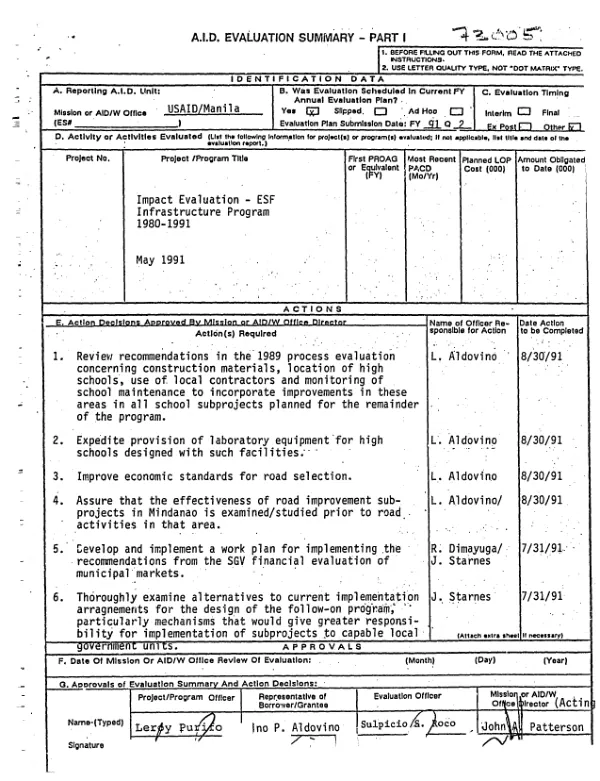
Evaluates project to fund the design of development projects in the Philippines which will be financed with Economic Support Funds (ESF).
Riley, William L.; Baking, Franklin · 1983
Sign in to readA free account is required to download.
Abstract
PES covers the period 7/80-12/82 and is based on document review and committee discussions by A.I.D. and Development Projects Fund Secretariat (DPFS) staff. Overall, the project is on target. The project has supported detailed site surveys, planning activities, feasibility and engineering design studies, and small scale pilot projects. The following studies have been completed and have laid the groundwork for ESF projects to be implemented by the DPFS in 1983: (1) the Clark Area Development Studies (Boundary and Subdivision Survey, Clark Area Development Plan, Soil Survey, and Detailed Engineering Plan); (2) the Rural Enterprise Sector Study; (3) the Clark Access Road Environmental Assessment; (4) the Olongapo City Solid Waste Management Study; (5) the Rural Energy Development Project; and (6) the Angeles City Market, Slaughterhouse, and Hospital Study. Short-term training has been provided to a DPFS staff member (in the A.I.D. Development Studies Program) and to the Farm Systems Development Corporation Resident Advisor (in a course on project management at the University of Connecticut). The project is supporting operating costs (salaries, equipment, travel) for the 75-member DPFS and for the management team of the Angeles City Municipal Development Fund Project. There is one outstanding issue: the Ministry of Agriculture has requested additional support for a detailed soil/water survey (as part of the Clark Area Development Study). However, USAID/P can issue no further funds until unexpended project design funds advanced to the Armed Forces of the Philippines have been refunded. Recommendations address the above problem, and also suggest that the DPFS should work to speed the liquidation of cash advances and avoid the use of more than one contractor per study, to prevent excessive costs and differences in operating style.
Related documents