USAID DEC
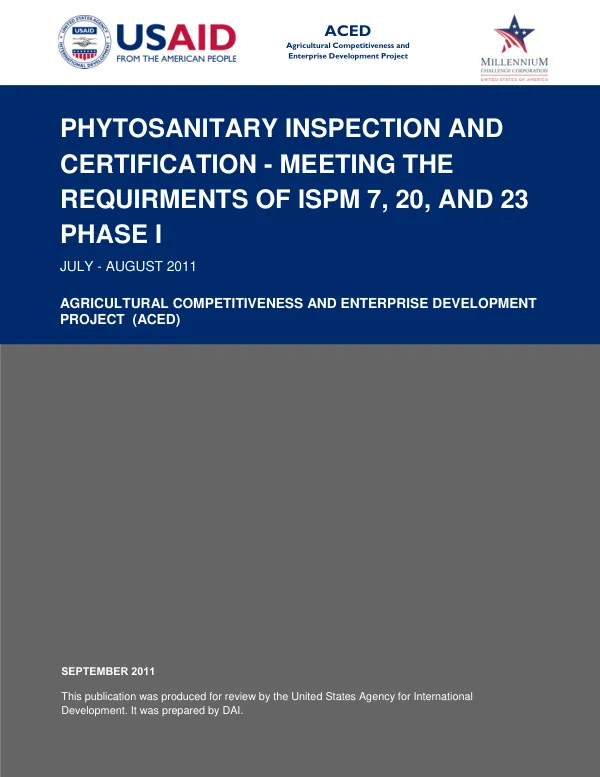
Phytosanitary Inspection and Certification - Meeting the Requirements of ISPM 7, 20, and 23 Phase I
Sign inDAI
Phytosanitary Inspection and Certification - Meeting the Requirements of ISPM 7, 20, and 23 Phase I
The Agricultural Competitiveness and Enterprise Development Project (ACED) in Moldova aimed to improve the country's phytosanitary inspection and certification systems to meet the requirements of ISPM 7, 20, and 23.
2011 · 16 pages
Sign in to readA free account is required to download.
Abstract
The project was sponsored by the USAID Ukraine Regional Contract Office and implemented by DAI. The ACED effort focused on rebuilding basic SPS capacity, including inspection, certification, and diagnostics, to ensure that the Government of Moldova's SPS systems met the basic requirements outlined in ISPM 7, 20, and 23. The phytosanitary group in Moldova lacked the equipment, process, and procedures to perform the required testing and diagnostics, which was a critical component of a phytosanitary control system. The 2009 assessment noted that there were laboratories that could support the phytosanitary group by providing testing for chemicals, especially pesticide residues, and pathogens within the government. However, the investments should be focused on areas unique to phytosanitary control. In April 2011, ACED conducted a rapid assessment of Moldova's SPS capacity, focusing on inspection, certification, and laboratory testing, to identify what had changed since 2009. The assessment found that little had changed since the initial assessment in 2009, and the Government of Moldova's phytosanitary system was lacking compliance with ISPM 7, 20, and 23. The senior management of the phytosanitary Inspectorate and Directorate had changed, leading to the need to introduce the program to the government officials, gain their buy-in, and re-develop a timeline that met the needs of the government and ACED. The ability to meet the requirements of ISPM 7, 20, and 23 are core competencies that the Moldovan government lacks. The government recognizes the need to improve their systems and processes and is willing to dedicate resources and time to this effort. The government is in the midst of change, with key leadership having changed, and the Ministry of Agriculture and Food Industry detailing a plan for an integrated single food agency that would combine key activities such as border inspection, certification, laboratories, and risk assessment. A path forward was agreed to on specific items to move the agency forward in preparation for the implementation of new inspection systems and processes required to meet the countries trading partner's expectations and obligations. The specific items include the development of key reference materials to be used by the inspectorate, including plants, weeds, and diseases in Moldova, a compendium of diseases, plants, and weeds of significance in harmonized with EU and EPPO requirements, and a list of quarantine pests, weeds, and diseases for Moldova harmonized with EPPO. The inspectorate and service are also interested in an upgraded web site that will include information for trading partners, laws and regulations, locations of inspection points, details the process of import and export certification, provides trading partners with updated information on diseases of concern in the Republic, and provides a secure area for use by the inspectorate personnel that would include training materials, reference materials, procedures, and possibly in the future on-line certificate development and issuance. The Director of the service and Chief of the inspectorate requested ACED's assistance in supporting the development of a relationship with the corresponding Romanian service. The purpose of this relationship is to support the Government of Moldova in their efforts to not only comply with ISPM standards but further to harmonize their systems of certification and inspection with EU norms. Developing a relationship with the Romanian service has significant benefits for the service and the ACED project, including the sharing of knowledge and information, which will increase the speed of development. The action plan, timeline, and specific responsibilities outlined in the next section were reviewed and agreed to with the Moldovan counterparts. This plan took into consideration the other activities that were on-going within the government and the availability of resources. The State Plant Protection Service and Phytosanitary Inspectorate have resource and time constraints due to the inception of the EU program, and the activities that have been agreed to are all they are willing to commit to for the year. The support of developing a relationship with the Romanian counterparts is of key importance to the ACED Moldovan counterparts, and they have requested ACED assistance in this area. This provides a significant opportunity for ACED if the program can be developed in a way that allows for knowledge and information sharing, which will increase the speed of development.