USAID DEC
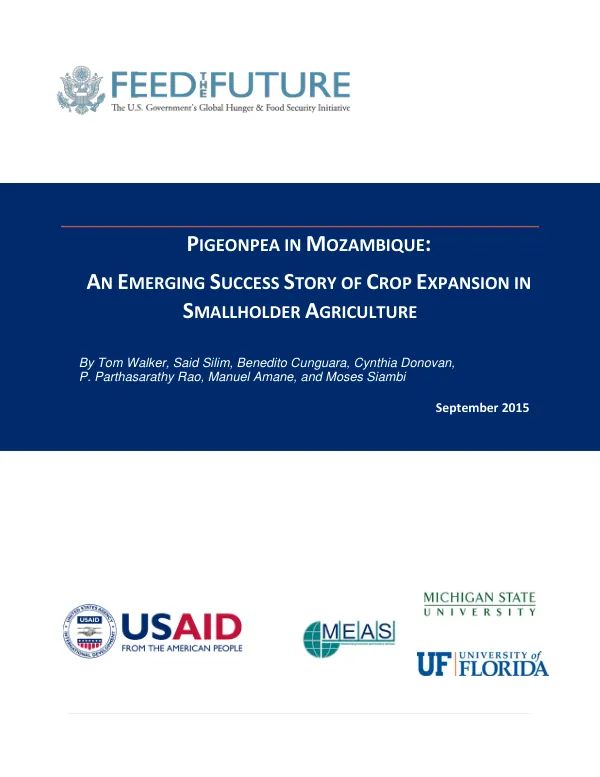
Pigeonpea in Mozambique: An Emerging Success Story of Crop Expansion in Smallholder Agriculture
Sign inMART PROJECT
Pigeonpea in Mozambique: An Emerging Success Story of Crop Expansion in Smallholder Agriculture
Pigeonpea in Mozambique: An Emerging Success Story of Crop Expansion in Smallholder Agriculture began in 2015 with the goal of assessing the expansion of pigeonpea in Central and North Mozambique.
2015 · 53 pages
Sign in to readA free account is required to download.
Abstract
The report was produced as part of the United States Agency for International Development (USAID) project "Modernizing Extension and Advisory Services" (MEAS) and funded by USAID/Mozambique. The expansion of pigeonpea in Mozambique is attributed to several factors, including its strengths relative to other grain legumes. Pigeonpea has a high protein content, is drought-tolerant, and has a long shelf life, making it an attractive crop for smallholder farmers. Additionally, the crop is relatively easy to grow and requires minimal inputs, making it a viable option for farmers with limited resources. The TIA/IAI Surveys conducted in 2008 and 2011 provided valuable insights into the expansion of pigeonpea in Mozambique. The surveys revealed that the production of grain legumes, including pigeonpea, increased significantly between 2002 and 2012. Pigeonpea production grew from 12,000 metric tons in 2002 to 43,000 metric tons in 2012, with the majority of production coming from Central and North Mozambique. The expansion path of pigeonpea in Mozambique was characterized by a shift from traditional to modern production systems. The crop was initially grown as a secondary crop, but with the introduction of new technologies and practices, it became a primary crop for many farmers. The adoption of pigeonpea was highest in areas with good market access and infrastructure, indicating that market demand played a significant role in the crop's expansion. Poverty effects of pigeonpea expansion were also assessed in the report. The results showed that the crop had a positive impact on household income and poverty reduction. Farmers who adopted pigeonpea reported higher incomes and reduced poverty levels compared to those who did not adopt the crop. Key institutions contributing to the expansion of pigeonpea in Mozambique included the Ministry of Agriculture and Food Security (MASA), the National Directorate of Economics, and the Institute of Food and Agricultural Sciences at the University of Florida (UF/IFAS). These institutions provided technical assistance, training, and support to farmers, which helped to promote the adoption of pigeonpea. The report also examined the prospects for pigeonpea in India, import demand, and export competitiveness. Global production of pigeonpea grew slowly in India but rapidly in other countries. Import demand from India was significant, with the country importing large quantities of pigeonpea from Mozambique and other countries. Mozambique's competitiveness among major exporters was also assessed, with the report concluding that the country had a strong competitive advantage in the global pigeonpea market. Finally, the report identified actions needed and not needed to reinforce supply response. The authors recommended that policymakers and stakeholders focus on improving market access, infrastructure, and institutional support to smallholder farmers. They also emphasized the need to address the challenges faced by farmers, including climate change, pests, and diseases. The findings and implications of the report were significant, highlighting the potential of pigeonpea to contribute to poverty reduction and economic growth in Mozambique. The report's recommendations provided a roadmap for policymakers and stakeholders to support the continued expansion of pigeonpea in the country.