USAID
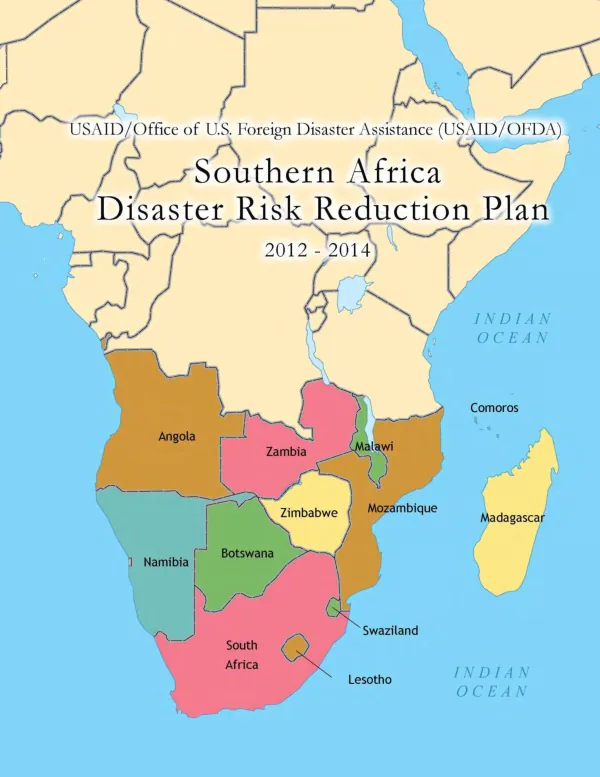
Southern Africa Disaster Risk Reduction Plan
The Southern Africa Disaster Risk Reduction Plan, 2012-2014, aims to reduce the impact of disasters on vulnerable populations in the region.
2012 · 6 pages
Sign in to readA free account is required to download.
Abstract
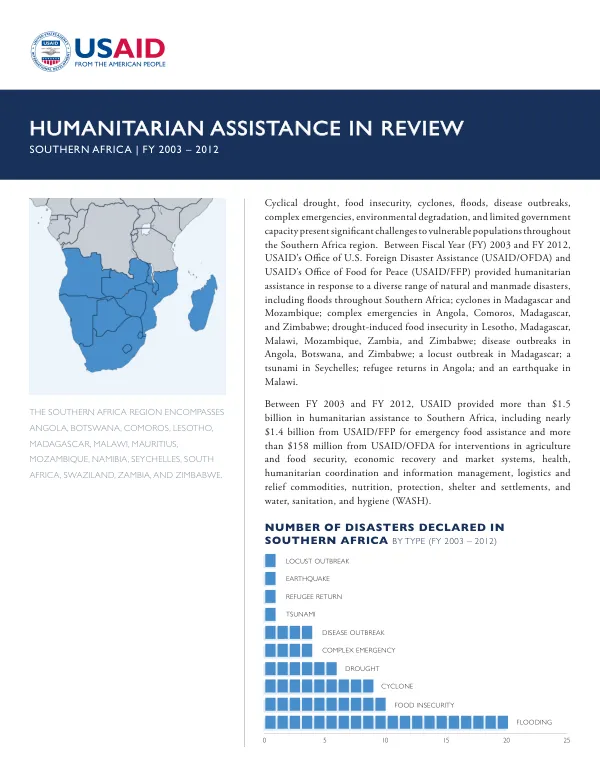
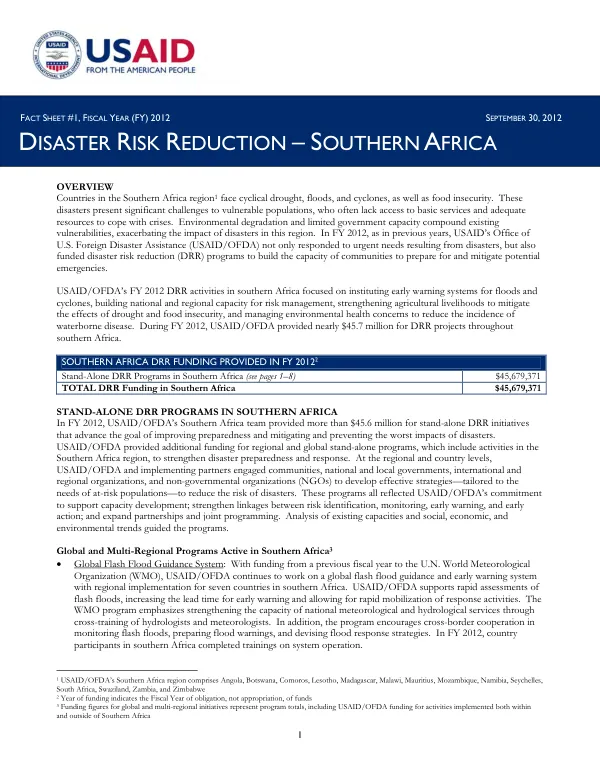
The plan is led by the Office of U.S. Foreign Disaster Assistance (USAID/OFDA) and focuses on disaster risk reduction through systematic efforts to manage the causal factors of disasters. Climate variability and rapid rural-to-urban migration are major challenges in the region, leading to high-risk informal settlements and limited market access. The plan addresses these issues by supporting applied research projects, pilot programs, and expansion of existing approaches to disaster risk reduction. USAID/OFDA will work with implementing partners, regional governments, other donors, and international organizations to achieve this goal. The region faces significant threats, including HIV/AIDS, weak governance, and climate extremes. These factors have led to increased vulnerability and fragility, particularly in areas with limited capacity to manage risks. The plan aims to mitigate the effects of climate extremes on livelihoods and livelihoods, focusing on disaster-prone households and communities. Climate extremes are the primary risk to lives and livelihoods in the region, and USAID/OFDA's programming will focus on managing risk, reducing impact, and strengthening recovery from disasters. The plan also emphasizes the importance of agricultural livelihoods, managing health concerns, and building capacity for risk management. Regional constraints, such as inadequate institutional capacity, institutional capacity, and limited availability of skilled personnel, will be addressed through the implementation of the plan. The plan will also prioritize the development of sustainable and adaptable capabilities in disaster risk reduction. Key findings and methodologies include: * Climate-induced hazards are the primary risk to lives and livelihoods in the region. * The region faces significant threats, including HIV/AIDS, weak governance, and climate extremes. * Climate extremes have a significant impact on livelihoods, natural resources, and socio-economic conditions. * The plan will focus on managing risk, reducing impact, and strengthening recovery from disasters. * USAID/OFDA will work with implementing partners, regional governments, other donors, and international organizations to achieve this goal. Implementation details include: * USAID/OFDA will support applied research projects, pilot programs, and expansion of existing approaches to disaster risk reduction. * The plan will prioritize the development of sustainable and adaptable capabilities in disaster risk reduction. The plan will be implemented over a period of two years, with a focus on disaster-prone households and communities. The plan will also prioritize the development of sustainable and adaptable capabilities in disaster risk reduction. Regional focus and context include: * The Southern Africa region includes Angola, Botswana, Comoros, Lesotho, Madagascar, Malawi, Mauritius, Mauritius, Mozambique, Namibia, Seychelles, South Africa, Swaziland, Zambia, and Zimbabwe. Timeframes and recommendations include: * The plan will be implemented over a period of two years. Recommendations include: * USAID/OFDA should continue to support applied research projects, pilot programs, and expansion of existing approaches to disaster risk reduction.
Related documents