USAID. MISSION TO MOZAMBIQUE
Pilot child survival project
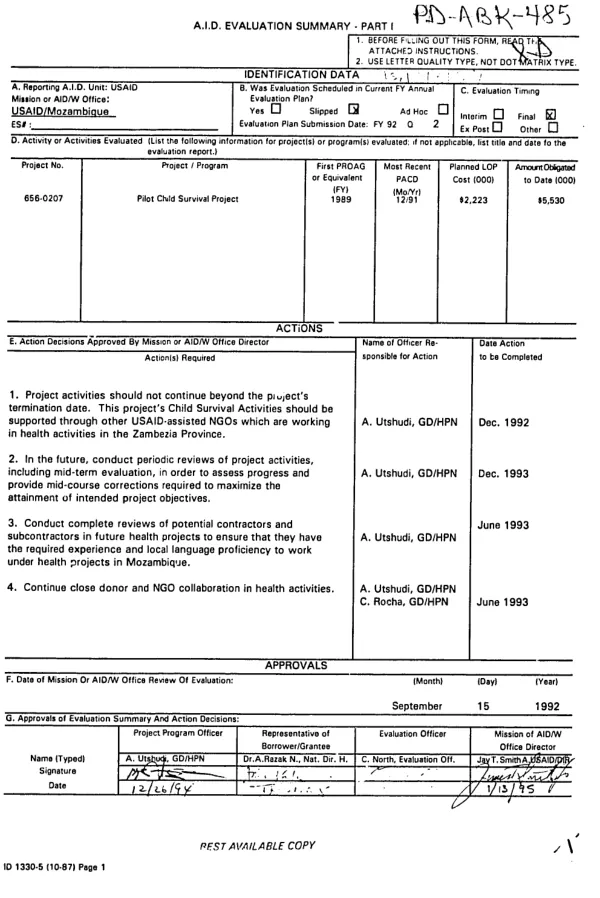
Summarizes attached final evaluation (XD-ABK-485-A) of a project (1989-91) to develop and test, under insurgency conditions, replicable and cost-effective measures to reduce infant and child morbidity in Mozambique.
1995
Sign in to readA free account is required to download.
Abstract
The project supported and strengthened management at selected health facilities managed by the Provincial Directorate of Health (DPS/Z). The support of air transportation was a positive contribution, enabling increased supervision, training, and communication with the districts targeted. In addition, the use of an established training institution which had a clear concept of training needs and the necessary skills provided guidance to project staff. On the negative side, the project was poorly integrated into ongoing activities of the Ministry of Health (MOH) due to the limited and apparently superficial contact of the long-term contractor (Johns Hopkins University) and USAID personnel with national and regional MOH officials. This problem manifested itself in the timing and handling of consultants, the inadequate communication of project plans and activities to appropriate levels of the MOH, and the lack of information on MOH plans and programs. Related problems included the project design"s failure to collaborate with the MOH in developing the scope of work of consultants and to clearly delineate the operational responsibilities of the various parties. Lessons learned are as follows. (1) Care must be taken not to underestimate the capacity of MOH leadership, staffing, or services. Insufficient knowledge of, or regard for, the plans, policies, and context of ongoing host country programs leads to serious problems during implementation. The caliber of leadership in Mozambique is high, and most senior officials know what is susceptible to change and what is not. Therefore, project activities should be planned and implemented jointly with Mozambicans at all levels, and the selection of contractors who are competent and sensitive to project goals and existing government policies is crucial. They should also be proficient in Portuguese. (2) Long-term advisors who work directly with the health structure are often more effective than personnel loosely connected to health structures. (3) Avoid emphasizing short-term, measurable goals over long-term process goals. (4) Clear statements of work are essential. (5) Small, negative effects (e.g., personality conflicts, misunderstandings, perceived commitments that go unfulfilled) can so color the project as to obscure the positive benefits that occur. (6) Communication gaps can often undermine the integration of project plans and activities with MOH priorities. (7) During times of insurgency, one of the most difficult problems is isolation of field workers. The morale and motivation of field staff can be improved by supervision and training visits that bring central and local officials together. (8) Working with a strong and effective organization (e.g., the Centro De Reciclagem) with consonant objectives can significantly increase implementation capacity and contribute to project sustainability. (9) Sustainability is critically influenced by the way the later stages of the project are handled. (10) The Mission can avoid many mistakes experienced in this project by a country-oriented analysis which incorporates consultation of key officials at several levels to sort out critical problems. Based on this information, the Mission can formulate its country strategy and performance indicators to find a mutually acceptable fit.