USAID
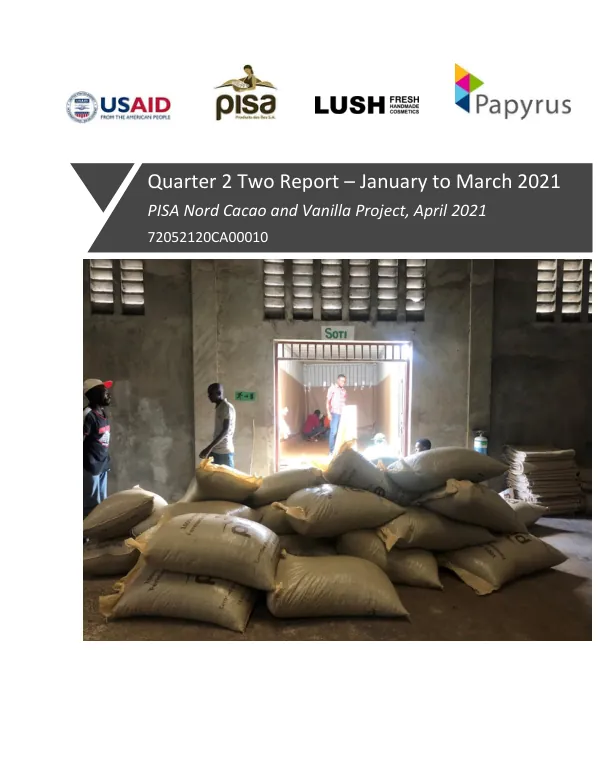
Quarter 2 Two Report – January to March 2021
The PISA Nord Cacao and Vanilla Project is a USAID-funded initiative aimed at improving the livelihoods of smallholder farmers in Haiti through sustainable cacao and vanilla production.
2021 · 12 pages
Sign in to readA free account is required to download.
Abstract
The project began in 2020 and is being implemented by Papyrus S.A. in partnership with the Haitian government and other stakeholders. Capacity development activities for APROCANO, a Haitian cacao cooperative, were a key focus of the project during the second quarter of 2021. A total of 526 people were trained in various aspects of cacao production and certification, including traceability, organic certification, and child labor prevention. The project also organized APROCANO's General Assembly, which validated the minutes of the previous assembly, introduced new producer cells from Limbé and Bas-Limbé, and presented activities, financials, and premium distribution to the assembly. On the commercial side, PISA signed contracts for the larger cacao harvest expected to peak in the next quarter. The company continued buying cacao throughout the quarter to ensure a continuous presence in the field and to purchase higher volumes. PISA exported 18 metric tons of cacao beans in January, generating US $67,830 in revenue. The company also collected 108 metric tons of wet beans from APROCANO farmers, worth 6.5 million gourdes. The project also made progress in diversifying its production system and establishing export conditions for new commodities. However, vanilla production and nursery activities were put on hold due to delays in technical assistance from LUSH experts. PISA worked on corrective actions recommended by the certification body for both organic and FFL certifications, conducting trainings for internal controllers, cacao buyers, and PISA workers. To expand the network of certified producers and increase volumes, PISA started recruiting new producers in the Acul du Nord area and creating three new producer cells. These new producers were trained on APROCANO's structure and organic and FFL principles, and will receive a visit from the internal controller to verify compliance. The project's value chain governance capacity was enhanced through the APROCANO Annual General Assembly, which validated the minutes of the previous assembly, introduced new producer cells, and presented activities, financials, and premium distribution to the assembly. The assembly also focused on the definition of child labor according to FFL certifiers and presented the 2021 APROCANO orientation plan. Overall, the PISA Nord Cacao and Vanilla Project made significant progress in the second quarter of 2021, focusing on capacity development, commercial activities, and value chain governance. The project's efforts aim to improve the livelihoods of smallholder farmers in Haiti through sustainable cacao and vanilla production. PISA exported a 20-foot container from the previous small harvest and contracted up to 300 metric tons for the upcoming large harvest. The company continued buying cacao throughout the quarter to ensure a continuous presence in the field and to purchase higher volumes. PISA also collected 108 metric tons of wet beans from APROCANO farmers, worth 6.5 million gourdes. The project's partnership with the MARNDR (Ministry of Agriculture) on the PITAG project will develop a clonal garden for cacao and vanilla on a plot of land currently contested by PISA. This partnership will mitigate PISA's direct investments on the land and lend credibility from the Ministry as to PISA's rightful ownership thereof. PISA will continue looking at other options to lease state-owned land or buy more land in the area to develop its own greenfield model. Cacao seedling production will resume in May for transplanting during the next rainy season from October to November. The annual certification survey that started this quarter will allow the project to identify the plots and producers who will participate based on yield and land availability. This survey will also allow PISA to estimate the number of seedlings that need to be produced. The project's focus on increasing volumes purchased through a stronger presence, price adjustments, and higher yields is expected to meet the high demand from buyers. PISA is also working on corrective actions recommended by the certification body for both organic and FFL certifications, conducting trainings for internal controllers, cacao buyers, and PISA workers. The project's efforts aim to improve the livelihoods of smallholder farmers in Haiti through sustainable cacao and vanilla production. The project's progress in the second quarter of 2021 demonstrates its commitment to achieving this goal.
Related documents