USAID
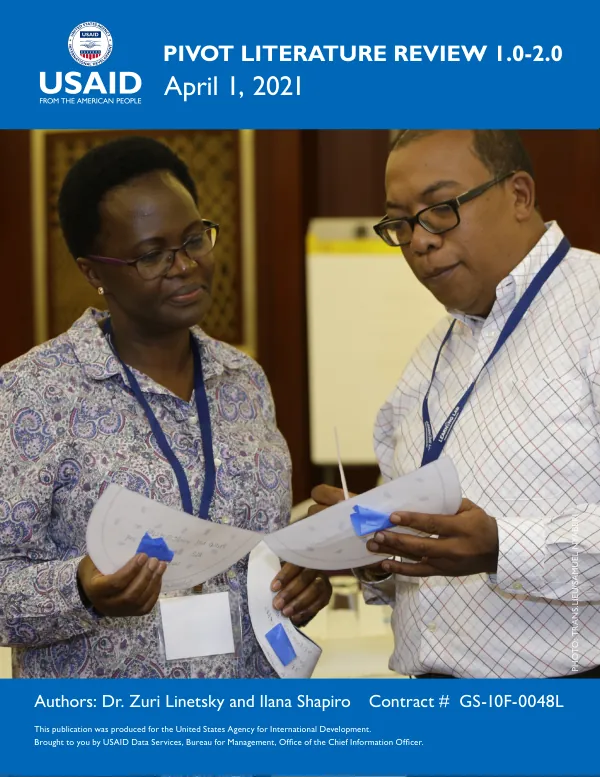
PIVOT Literature Review 1.0-2.0
The PIVOT Cohort program, launched by USAID's Africa Bureau Division for Economic Growth, Environment, and Agriculture (EGEA) in March 2019, aims to build internal capacity, commitment, and community that advance private-sector engagement (PSE) as a pathway to self-reliance.
2021 · 46 pages
Sign in to readA free account is required to download.
Abstract
The program works with field staff in six Missions in Africa to capture learning from both the implementation and outcomes of the PIVOT Cohort program, as well as contribute evidence related to questions on the Self-Reliance Learning Agenda (SRLA). Research evidence on PSE capacity building, experiential/on-the-job training, peer- and team-based learning, and change management relevant to the PIVOT Cohort program highlights the importance of an integrated approach to PSE capacity building. This approach combines technical PSE knowledge and skills with interpersonal skills, such as effective communication, cooperative planning and problem-solving, and adaptive management. Best practices also recognize the importance of good relationships and relationship management in PSE success, and the role of "soft skills" in uncovering alignment, building trust, and treating partnerships as relationships rather than transactional contracts. Organizational enabling conditions for PSE are critical to the success of the PIVOT Cohort program. Leadership support is among the most widely recognized factors needed to create an organizational enabling environment for PSE. Best practices recognize the importance of PSE buy-in by leaders and ownership by front line implementers within the organization. Additionally, studies highlight the importance of integrating staff incentive structures into organizations, including linking employee reward systems with PSE performance, and allocating staff time for building relationships with private-sector actors and for managing change. The PIVOT 2.0 program builds on the work of the PIVOT 1.0 program and adds focused training on navigating internal and external power dynamics and mindfulness to its training curriculum. The PIVOT 2.0 literature review examines the academic literature on navigating power dynamics and mindfulness and links these areas of research to PSE and the overall objectives of the PIVOT training program. Understanding the PIVOT 1.0 literature review is necessary for contextualizing the PIVOT 2.0 literature review, which seeks to add to the work of the preceding document. The PIVOT 2.0 literature review focuses on the academic literature on navigating power dynamics and mindfulness and links these areas of research to PSE and the overall objectives of the PIVOT training program. The review examines the concept of power dynamics, including external and internal power dynamics, and the role of mindfulness in navigating these dynamics. The review also discusses the importance of listening and employing local knowledge, reconsidering measurement, and incorporating mindfulness and navigating power dynamics into PSE. The PIVOT 2.0 program's design and implementation are informed by the PIVOT 1.0 literature review, which highlights the importance of an integrated approach to PSE capacity building, organizational enabling conditions for PSE, and the role of leadership support in creating an organizational enabling environment for PSE. The PIVOT 2.0 program builds on this foundation and adds focused training on navigating internal and external power dynamics and mindfulness to its training curriculum. The program's approach is designed to help participants develop the skills and knowledge needed to navigate complex power dynamics and to apply mindfulness in their work. The PIVOT 2.0 literature review highlights the importance of navigating power dynamics and mindfulness in PSE. The review examines the concept of power dynamics, including external and internal power dynamics, and the role of mindfulness in navigating these dynamics. The review also discusses the importance of listening and employing local knowledge, reconsidering measurement, and incorporating mindfulness and navigating power dynamics into PSE. The PIVOT 2.0 program's approach is designed to help participants develop the skills and knowledge needed to navigate complex power dynamics and to apply mindfulness in their work.