USAID. MISSION TO HONDURAS
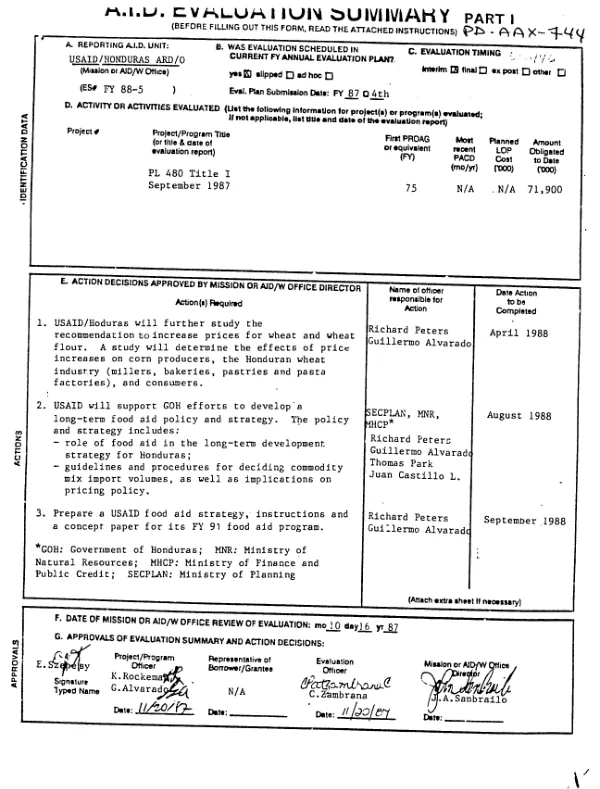
PL-480 Title I, September 1987
Summarizes external impact evaluation (PD-AAW-647) of P.L.
1987
Sign in to readA free account is required to download.
Abstract
480 Title I wheat imports in Honduras over the period 1975-86. The evaluation was based on analyses of secondary data and interviews with Honduran personnel. Between 1975 and 1986, 405,325 MT of wheat and small amounts of rice and tallow have been imported under the program (Title I now accounts for 80% of wheat imports). A total of 137 million lempiras have been generated from Title I sales and used to finance development activities. The evaluation"s main conclusions follow. (1) Wheat provides 12% of the country"s daily protein intake, and 10% of the calories. The consumption patterns for wheat are strongly biased in favor of urban and upper-income population groups. (2) Wheat imports have caused corn prices to decrease. But, wheat imports would have occurred in the absence of P.L. 480 since they are demand-driven. Wheat flour prices have decreased in real terms. Wheat prices are subsidized by the overvalued lempira and the low international prices reflecting production subsidies. (3) Local currency generations are not a very significant portion of the government budget (1.5%) but they are a significant share of the net budget of the Ministry of Natural Resources (MNR) (32%), and an even higher share of the net MNR budget funded from domestic revenues (56%). On the balance of payments side, Title I has meant a considerable savings of foreign exchange for Honduras. In addition to deferred principal payments, there have been interest savings. (4) However, the importance of Title I in the MNR budget has not led to a perceptible strengthening of the institution. Title III projects (an adjunct program) have had the most impact on agricultural productivity and on export crops; in fact, MNR expenditures as a whole have had little impact on domestic staple crops to date. Because of the tighter controls associated with the debt forgiveness feature of Title III programs and their grant nature Title III programs are easily the most effective of the P.L. 480 programs. The report recommends: (1) an increase in wheat flour and wheat prices to compensate for the overvalued exchange rate and/or to diversify the import commodity mix; (2) concentration of local currency generations in fewer programs for better control and developmental impact; and (3) the implementation of a Title III program in Honduras. See also abstract of PD-AAW-647. (Author abstract)
Related documents