THE NATURE CONSERVANCY
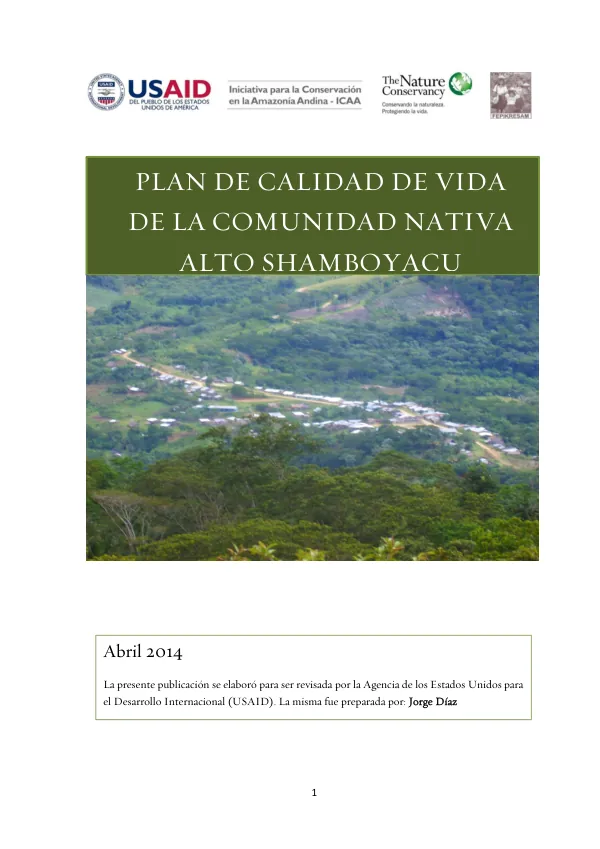
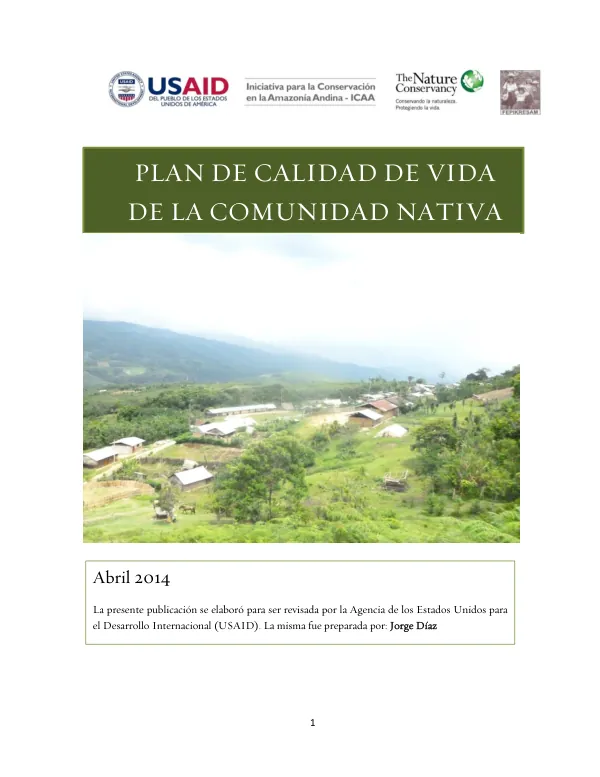
Plan de Calidad de Vida de la Comunidad Nativa Aviación
The community of Aviación is a native community located in the District of San Roque de Cumbaza, Province of Lamas, Region of San Martín.
2014 · 94 pages
Sign in to readA free account is required to download.
Abstract
The community has a total population of 630 inhabitants, representing 112 families. The community is situated in a region with a humid tropical premontane forest, characterized by a temperature range of 24°C and an annual precipitation of 1625 mm. The community's territory is 2978 hectares in size and is located in the Zone of Amortiguamiento of the Cordillera Escalera Conservation Area. The landscape is characterized by a rugged geography, with secondary forests, traditional chacras, and primary forests. The community has a unique cultural identity, with the Kechwa Lamas ethnic group being the predominant population. The community has a rich history, dating back to 1929 when the founder, Wawki José Sangama Amasifuén, settled in the Fundo Chontal de Mishquiyacu. The community has grown over the years, with the establishment of the first primary school in 1970 and the creation of the Caserío Aviación in 1990. The community was officially recognized as a Native Community by the Peruvian State in 1997, through Resolution Directoral 128-97-CTAR. The community's access to services and infrastructure is limited, with the nearest city, Tarapoto, being 50 minutes away by car. The community has a carretera afirmada, which is a dirt road, and the community is accessible by foot or by car. The community's importance lies in its role as a source of water for the cities of Lamas and Tarapoto, with the Cumbaza River being the main water source. The community has a unique cultural identity, with the Kechwa Lamas ethnic group being the predominant population. The community has a rich history, dating back to 1929 when the founder, Wawki José Sangama Amasifuén, settled in the Fundo Chontal de Mishquiyacu. The community has grown over the years, with the establishment of the first primary school in 1970 and the creation of the Caserío Aviación in 1990. The community's development is focused on improving the quality of life of its inhabitants, with a focus on social, economic, cultural, and environmental development. The community has identified several challenges, including limited access to services and infrastructure, limited economic opportunities, and limited environmental conservation efforts. The community has developed a plan to address these challenges, with a focus on improving access to services and infrastructure, promoting economic development, and conserving the environment. The community's plan includes several initiatives, including the development of a community-managed water system, the establishment of a community-managed forest, and the promotion of sustainable agriculture practices. The community has also identified several priorities, including the improvement of access to education and healthcare, the promotion of economic development, and the conservation of the environment. The community's plan is based on a participatory approach, with the community being actively involved in the decision-making process. The community has identified several key stakeholders, including the community members, the community leaders, and the external organizations that provide support to the community. The community has also identified several key challenges, including limited resources, limited capacity, and limited access to information. The community's plan is focused on improving the quality of life of its inhabitants, with a focus on social, economic, cultural, and environmental development. The community has identified several priorities, including the improvement of access to education and healthcare, the promotion of economic development, and the conservation of the environment. The community's plan is based on a participatory approach, with the community being actively involved in the decision-making process.
Related documents