AGENCIA DE LOS ESTADOS UNIDOS PARA EL DESARROLLO INTERNACIONAL
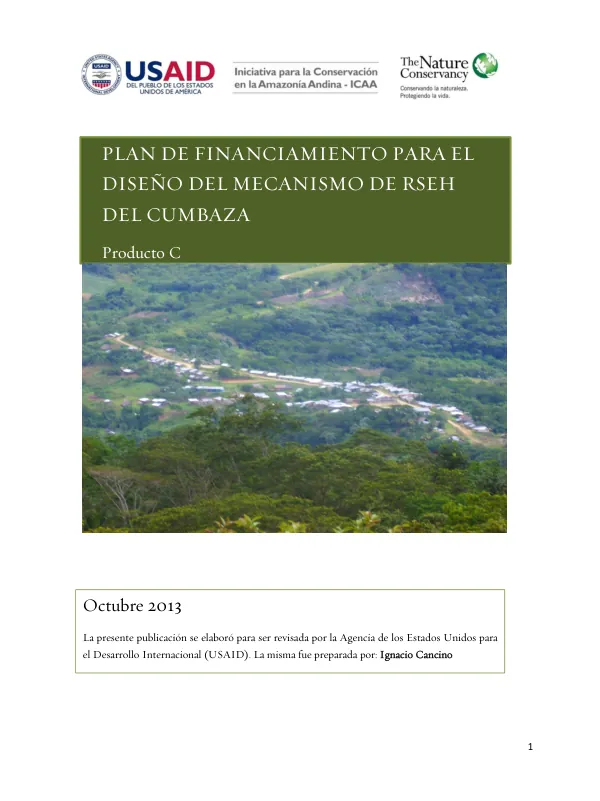
Plan de Financiamiento para el Diseño del Mecanismo de RSEH del Cumbaza
The Centro de Desarrollo e Investigación de la Selva Alta-CEDISA, a non-governmental organization, promotes rural development and conservation of natural resources and the environment in the San Martín Region.
2013 · 19 pages
Sign in to readA free account is required to download.
Abstract
In the last ten years, it has promoted agroforestry in the Mayo, Cumbaza, Ponaza, and Mishquiyacu river basins and conducted a justifying study that allowed the creation of the Cordillera Escalera Regional Conservation Area (ACR-CE). The ACR-CE is located in the San Martín Region, in the provinces of Lamas and San Martín, covering an area of 149,870 hectares. It is considered of strategic importance for the conservation of biodiversity in the region and as a source of water for different uses due to the five river basins that originate there. The area is crossed by the Tarapoto-Yurimaguas section of the IIRSA Norte highway and is subject to population occupation pressures, illegal logging, and changes in land use. The Cumbaza River Basin, which originates in the western flank, has special importance due to the growing scarcity and degradation of its water resources for different uses, a situation that worsens during the dry season. The basin covers an area of approximately 57,120 hectares, representing 1.14% of the total area of the San Martín Region. The hydrological network is composed of the Cumbaza River as the main axis, with its main tributaries on the left bank being the Cachiyacu, Shilcayo, Ahuashiyacu, and Pucayacu rivers, and on the right bank, the Shupishiña stream. According to the Ecological-Economic Zoning of the Cumbaza River Basin, carried out by the Huallaga Central and Bajo Mayo Special Project, 85% (48,552 hectares) of the basin has been deforested for agricultural, forestry, and livestock activities, while only 15% (8,568 hectares) corresponds to primary forests that have not been intervened, mainly located in the ACR-CE and Kechwa-Lamas Native Communities in the headwaters of the basin and its tributaries. With the aim of contributing to the conservation of forests and environmental goods and services, CEDISA has been implementing the "Payment for Environmental Services for the Conservation of Forests and Poverty Alleviation in the Cumbaza River Basin, San Martín Region" project (PSAH-Cumbaza), with the purpose of developing a mechanism for retribution for environmental services (RSAH) to overcome the bottlenecks for the conservation of ecosystem services in the Cumbaza River Basin. In the context of this project, the Cumbaza River Basin Management Committee (CGCC) was reactivated as a space for articulation and coordination of public and private actors with an interest in the conservation and sustainable development of the basin. The CGCC aims to promote the integrated and sustainable management of water and natural resources in the Cumbaza River Basin, and for this reason, it is the space called to constitute itself as the actor that will lead the promotion, design, implementation, and administration of a RSAH mechanism that CEDISA promotes, thanks to the support of the Inter-American Institute for Cooperation on Agriculture (IICA); and the Impulse Group for RSAH Mechanisms formed by the Huallaga Central and Bajo Mayo Special Project (PEHCBM), EMAPA San Martín, GIZ/PDRS, and CEDISA. The Inter-American Institute for Cooperation on Agriculture (IICA) through the Sustainable Forest Management Program in the Andean Region identifies the Retribution for Ecosystem Services (RSE) of forests for the maintenance of hydrological processes as an innovative scheme for financial sustainability in the management of river basins and the conservation of forests. To date, IICA implements two initiatives of RSE in the country, being the project executed by CEDISA, "Payment for Environmental Services for the Conservation of Forests and Poverty Alleviation in the San Martín Region," the first rapid-start project of the MFS Program. The Iniciativa para la Conservación de
Related documents
Documents in this collection
 2015
2015USAID DEC
CONSULTORÍA PARA LA ELABORACIÓN DE LA COMPROBACIÓN DE LOS MAPAS DE ZONIFICACIÓN AGROECOLÓGICA GENERADOS POR EL CISAS PARA LOS RUBROS DE CAFÉ, CACAO, GANADERÍA, PISCICULTURA Y CICLO CORTO Y EL MAPA DE USO Y COBERTURA VEGETAL GENERADO POR EL MAE DEL AÑO 2014
Open record 2013
2013USAID DEC