USAID DEC
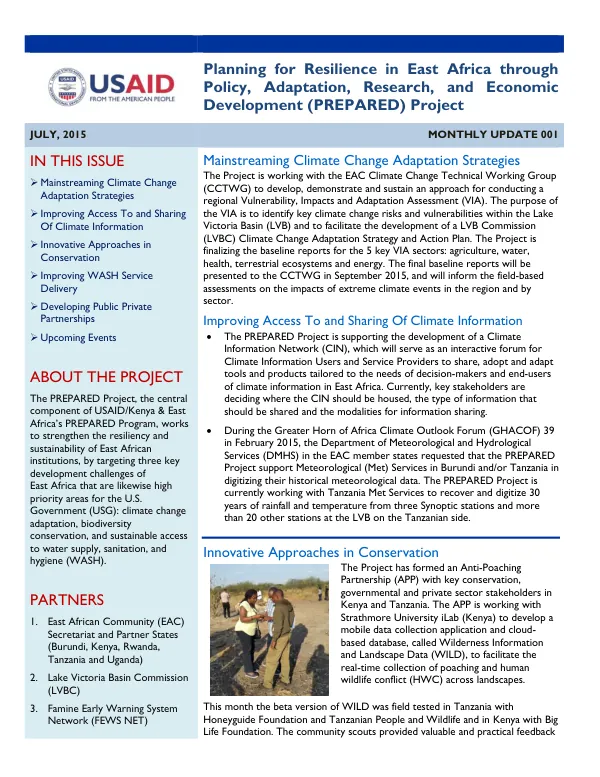
Planning for Resilience in East Africa through Policy, Adaptation, Research, and Economic Development (PREPARED) Project
Sign inTETRA TECH ARD, INC.
Planning for Resilience in East Africa through Policy, Adaptation, Research, and Economic Development (PREPARED) Project
The PREPARED Project, a central component of USAID/Kenya & East Africa's PREPARED Program, aims to strengthen the resiliency and sustainability of East African institutions by addressing three key development challenges: climate change adaptation, biodiversity conservation, and sustainable access to water supply, sanitation, and hygiene (WASH).
2015 · 2 pages
Sign in to readA free account is required to download.
Abstract
The project targets East Africa, specifically the East African Community (EAC) member states of Burundi, Kenya, Rwanda, Tanzania, and Uganda, as well as the Lake Victoria Basin. The project is working with the EAC Climate Change Technical Working Group (CCTWG) to develop, demonstrate, and sustain an approach for conducting a regional Vulnerability, Impacts, and Adaptation Assessment (VIA). The VIA aims to identify key climate change risks and vulnerabilities within the Lake Victoria Basin and facilitate the development of a Lake Victoria Basin Commission (LVBC) Climate Change Adaptation Strategy and Action Plan. The project is finalizing baseline reports for the five key VIA sectors: agriculture, water, health, terrestrial ecosystems, and energy. The PREPARED Project is also supporting the development of a Climate Information Network (CIN), which will serve as an interactive forum for Climate Information Users and Service Providers to share, adopt, and adapt tools and products tailored to the needs of decision-makers and end-users of climate information in East Africa. The project is currently working with Tanzania Met Services to recover and digitize 30 years of rainfall and temperature data from three Synoptic stations and more than 20 other stations at the Lake Victoria Basin on the Tanzanian side. Innovative approaches in conservation are also being implemented through the project. An Anti-Poaching Partnership (APP) has been formed with key conservation, governmental, and private sector stakeholders in Kenya and Tanzania. The APP is working with Strathmore University iLab to develop a mobile data collection application and cloud-based database, called Wilderness Information and Landscape Data (WILD), to facilitate the real-time collection of poaching and human wildlife conflict (HWC) across landscapes. The beta version of WILD was field tested in Tanzania and Kenya, and the community scouts provided valuable and practical feedback. The project has also partnered with Itron, a leading global water meter engineering firm, and the Uganda National Water and Sewerage Company (NWSC) to combat Non-Revenue Water (NRW) in the districts of Jinja and Iganga. The partnership aims to reduce NRW in Uganda from 45% to 20% over the next 12 months. The project has also introduced a Quality Service Improvement Program (QSIP) that focuses on improving engagement, communication, and accountability with customers. Discussions are underway with Water and Sanitation Corporation (WASAC) in Rwanda and Urban Water Supply and Sewerage Authority (UWSA) in Tanzania to explore the potential of expanding the NRW Reduction Partnership to these countries. Developing public-private partnerships is also a key component of the project. A meeting was held with representatives from Badische Anilin-und Soda-Fabrik (BASF) Company-Germany, the Mara-Serengeti Transboundary Hoteliers Forum (TBHF), and the Kenya National Environment and Management Authority (NEMA) to agree on the parameters of the partnership for wastewater reduction in the Mara-Serengeti landscape. The partnership will support resource efficiency in hotel operations in the Mara, with particular emphasis on water usage and water cycles, and institutionalize best practices and standards in resource efficiency for hotels in the Lake Victoria Basin and EAC. Upcoming events include the Vulnerability Index Mapping Course and United States Geological Survey (USGS) Land Coverage Course, scheduled for August 10-20, 2015, in Entebbe, Uganda. The Non-Revenue Water (NRW) Quality Service Improvement Program (QSIP)-Training of Trainers (ToT) will take place on August 18-20, 2015, in Kampala, Uganda. The Greater Horn of Africa Climate Outlook Forum (GHACOF) 41 is scheduled for August 24-25, 2015, in Dar es Salaam, Tanzania. The Lake Victoria Region Local Authorities Cooperation (LVRLAC) QSIP Training will be held on August 26-27, 2015, in Kisumu, Kenya.