USAID DEC
Policy Brief: Engaging Communities in the Establishment of a Patient-Centered Approach in Public Hospitals
Sign inUSAID
Policy Brief: Engaging Communities in the Establishment of a Patient-Centered Approach in Public Hospitals
The Health Reform Implementation Support Group (HRISG) has identified the need for public hospitals in Albania to adopt a patient-centered approach.
2014 · 3 pages
Sign in to readA free account is required to download.
Abstract
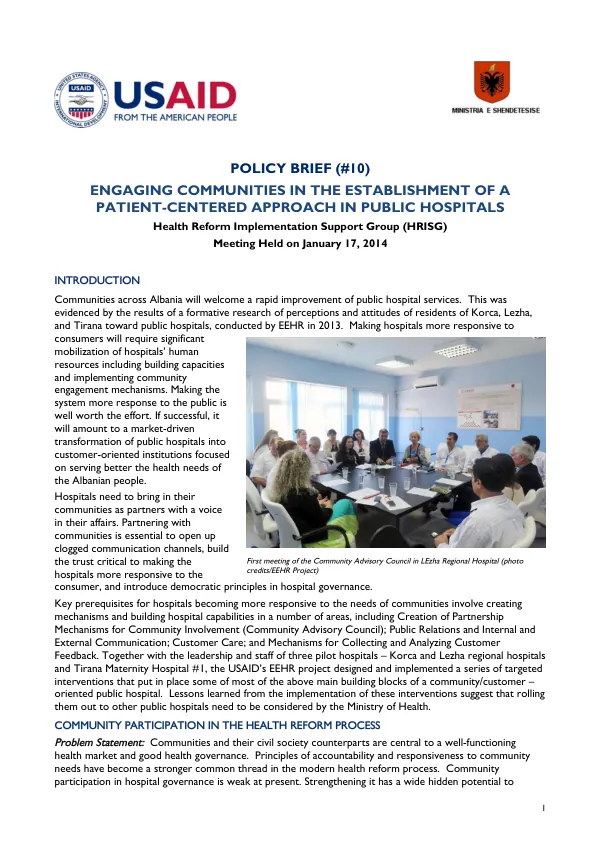
This initiative aims to improve public hospital services by making them more responsive to consumers. A formative research study conducted by EEHR in 2013 revealed that communities across Albania are eager for a rapid improvement in public hospital services. The study highlighted the importance of mobilizing hospitals' human resources, including building capacities and implementing community engagement mechanisms. To achieve this goal, hospitals need to partner with their communities as equals, with a voice in their affairs. This partnership is essential for opening up clogged communication channels, building trust, and introducing democratic principles in hospital governance. Key prerequisites for hospitals becoming more responsive to community needs involve creating mechanisms and building hospital capabilities in areas such as community involvement, public relations and internal and external communication, customer care, and collecting and analyzing customer feedback. The USAID's EEHR project has designed and implemented a series of targeted interventions in three pilot hospitals - Korca and Lezha regional hospitals and Tirana Maternity Hospital #1. These interventions aimed to put in place the building blocks of a community/customer-oriented public hospital. Lessons learned from the implementation of these interventions suggest that rolling them out to other public hospitals should be considered by the Ministry of Health. Community participation in hospital governance is weak in Albania, and strengthening it has a wide potential to harness critical public support for successful health system strengthening. Communities need to be engaged to express their preferences as consumers, provide input to institutional decision-making in healthcare, and offer their feedback on the performance of healthcare providers. This requires creating proper mechanisms for community involvement, such as the Community Advisory Council (CAC). The establishment of CACs has been viewed positively by all members, community and hospital staff representatives, who see the benefit of a transparent process where issues, problems, and solutions are openly discussed. The EEHR project has also worked with selected staff from the three pilot hospitals to build their capabilities for supporting hospitals' communication and PR needs. Trainings and on-the-job support were provided to help hospital staff learn from practice important technical aspects of good communication and PR. Hospital annual communication plans were developed and approved for implementation in 2014. Recognizing the function of PR and Communication as essential for hospitals to engage effectively with communities, public and private institutions, journalists, and other hospital stakeholders is crucial. Hospitals need to establish and maintain standards for customer care, making the hospital environment more welcoming to customers and inviting communities to return to the hospitals in expectation of better treatment.