USAID DEC
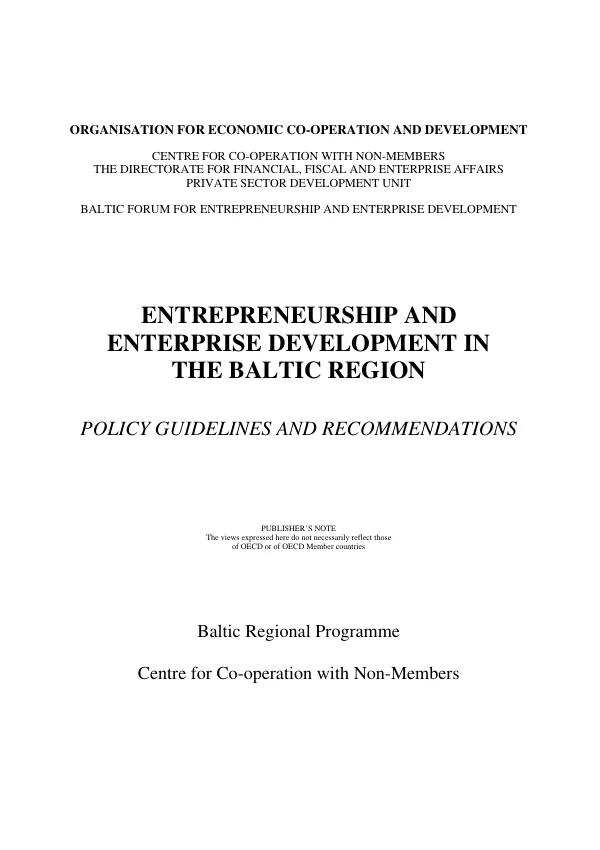
Policy Guidelines and Recommendations for Entrepreneurship and Enterprise Development in the Baltic Region
Sign inTHE INTERNATIONAL BANK FOR RECONSTRUCTION AND DEVELOPMENT
Policy Guidelines and Recommendations for Entrepreneurship and Enterprise Development in the Baltic Region
The Baltic region is on the threshold of a new era, with the resources of the region offering the prospect of a vigorous regional economy and sustainable progress in economic development.
74 pages
Sign in to readA free account is required to download.
Abstract
The governments of the region can play a significant role in fostering economic development and, in particular, the environment for entrepreneurship and enterprise development. This is a major challenge for the new market economies in the region. Worldwide, small business is now seen as a crucial component of national development and as a key provider of new jobs, contributor to economic growth and regional development. For countries in transition to market economies, the growth of small business is vital. Restructuring existing industry is important, but equally important is the need to maximise the growth of new business. The Baltic Forum for Entrepreneurship and Enterprise Development (Baltic FEED) was established with that central aim in mind. The Baltic FEED provides a unique forum for OECD Member countries, Baltic states and adjacent regions of the Russian Federation, international organisations and private sector representatives to share knowledge and experience on small business policy. The 'best practices' in SME policy development, presented in these Policy Guidelines and Recommendations, are distilled from the rich and diverse practical experience across the region and within OECD Member countries, in devising and implementing such policy. The Baltic FEED is founded on the premise that successful policy development cannot be copied, nor provided unfiltered by other countries or organisations. There are many lessons to be learned, many ideas to be gleaned and adapted from OECD Member countries, but experience shows that there is no single country model that can be adopted. Across OECD Member countries, there are many common aspects to enterprise policy, but the details of their approaches vary. National cultures shape national institutions and influence economic values. Successful policies in enterprise promotion and enterprise development derive from well-managed economies, which respond imaginatively and continually to the specific problems they face. Countries that embrace the global, national and local dimensions of policy are best positioned to succeed in stimulating enterprise. The continuing FEED process has three key elements: the process of sharing experience and reviewing opportunities and obstacles to entrepreneurship, the distillation of the views and assessments by the delegates, and the implementation of the many Recommendations. The OECD has consistently pointed to entrepreneurship as a crucial element in creating vibrant market economies. Entrepreneurs are essential agents of change in the process of transition from a centrally planned to a market economy. They are the catalysts of growth, marrying capital, innovation and skilled people. The OECD has focused its work in this area in recent years on developing specific programmes for countries of the former Soviet Union and countries in transition to market economy. The Baltic FEED was launched by the OECD as a part of the Baltic Regional Programme. The overall objective of the Regional Programme is to provide a vital contribution to sustainable economic development and to the better integration of the Baltic countries into the global market economy. The Baltic FEED, based on wide participation from the Baltic Rim region and a continuing process of policy discussion, was designed to address this issue. The Baltic FEED covers Estonia, Latvia, Lithuania, and Russian Federation regions of St. Petersburg and Kaliningrad, and has been developed in dialogue between these countries and the OECD Member countries in the Baltic Rim. This region shares the common coastline of the Baltic Sea, and has strong cultural, historic, economic and trade linkages. For these reasons, OECD considers that these three Baltic countries and the two Russian Federation regions form an appropriate region for a separate FEED programme. The Baltic FEED has held two working party meetings: in Helsinki, Finland (November 11 - 13, 1998) and in Jönköping, Sweden (March 30 - April 1, 1999) and an Annual Meeting in Riga, Latvia, September 28 - 30, 1999. A subsequent meeting of the FEED Steering Group was held in Jönköping (17th January, 2000). The purpose of these meetings was to allow Ministers, public officials, small and medium-sized enterprise (SME) experts, and private sector representatives from the participating countries, representatives from the OECD Member countries and international organisations to share experiences on enterprise promotion and development. The meetings were hosted by the governments of Finland, Sweden (in co-operation with the Jönköping International Business School) and Latvia respectively. The discussions covered diagnoses of the problems for entrepreneurs and SMEs in the transition countries based on case studies and practical experience from the region, and sought to reach common understanding and guidelines on two main questions: how to develop and implement better enterprise policies and programmes, and what constituted 'best practice' in undertaking that task. OECD Member countries participating in the Baltic FEED are: Denmark, Finland, Germany, the Netherlands, Norway, Poland, Sweden, United Kingdom and the United States. Moreover, a number of international organisations such as the European Union, the EBRD and USAID as well as chambers of commerce and industry representative organisations played a central role in the work of the Baltic FEED. Six topics had been identified within the preparatory process