DAI GLOBAL, LLC
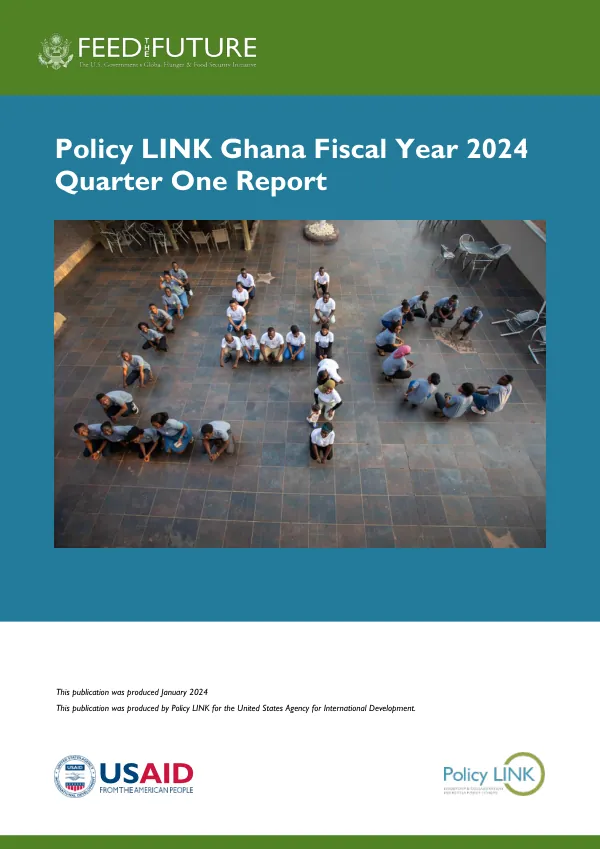
Policy LINK Ghana Fiscal Year 2024 Quarter One Report
The agricultural sector in Ghana has been a key driver of the country's economy, contributing an average of 20 percent of GDP between 2017 and 2022.
2024 · 33 pages
Sign in to readA free account is required to download.
Abstract
The sector employs an average of 38.3 percent of the total workforce. The Government's flagship program, Planting for Food and Jobs (PFJ), has boosted the sector's GDP growth, with an average rate of 6.3 percent between 2017 and 2021. To consolidate this gain, the Government waived import duties on agricultural machinery, equipment, and inputs not available locally, reducing production costs and making the sector more attractive. Policy LINK collaborated with the Ministry of Food and Agriculture (MoFA) to host Development Partners (DPs) at a Presidential Breakfast Meeting as part of the PFJ Phase 2 consultations. The event provided a platform for Policy LINK to present findings from a mapping exercise, which assessed the alignment of DPs' investments in the sector with the PFJ Phase 2 objectives. The Ministry also engaged with the private sector, youth, and financial institutions to gather inputs towards finalizing the PFJ Phase 2 Framework. The Ghana Statistical Service recorded a decline in the inflation rate, reaching 23.2% as of December 2023, a 3.2%-point decrease from the November figure of 26.4%. Despite this positive trend, customers continue to grapple with high food prices attributed to profiteering by intermediaries. For example, while maize prices dropped 50%, the drop was not reflected in consumer prices. The fall in inflation in the months preceding the IMF Board's acceptance of Ghana's extended credit facility is significant, supporting the country's attempts to address economic challenges. Policy LINK's efforts to support the PFJ Phase 2 consultations have focused on aligning Development Partners' investments with the program's objectives. A mapping exercise was conducted to assess the alignment of DPs' investments, and findings were presented to stakeholders at the Presidential Breakfast Meeting. The Ministry of Food and Agriculture also engaged with various stakeholders to gather inputs towards finalizing the PFJ Phase 2 Framework. The PFJ Phase 2 Framework aims to consolidate the gains made by the sector, with a focus on reducing production costs and making the sector more attractive. The framework also seeks to address the challenges faced by the sector, including high food prices and profiteering by intermediaries. Policy LINK's support for the PFJ Phase 2 consultations is critical to ensuring that the framework is aligned with the needs of the sector and the country's economic development goals.
Related documents