GOVERNMENT OF GHANA
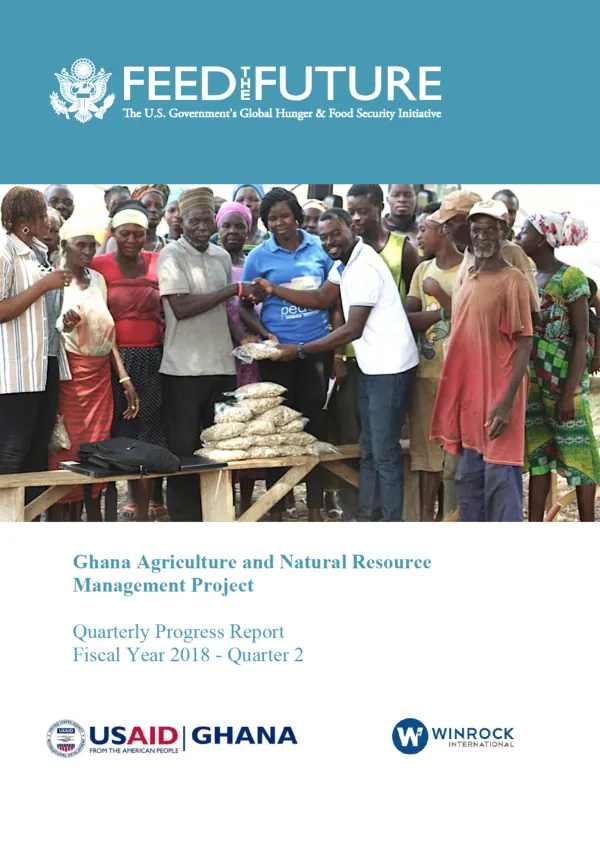
Feed the Future Ghana AgNRM Quarterly Progress Report (FY 2018|Quarter 2)
The Feed the Future Ghana Agriculture and Natural Resource Management (AgNRM) project is a five-year, $24,900,000 program that will run from May 2, 2016, to April 30, 2021.
2018 · 40 pages
Sign in to readA free account is required to download.
Abstract
It is the main vehicle within the United States Agency for International Development (USAID) Ghana's Feed the Future portfolio to address issues of environment and natural resource management (NRM) in northern Ghana. Winrock International implements AgNRM in partnership with TechnoServe, Nature Conservation Research Centre, and Center for Conflict Transformation and Peace Studies. The project supports USAID|Ghana's Development Objective 2 and the Ghana Feed the Future Multi-Year Strategy. The project's approach focuses on mutually reinforcing, systemic changes that align with and augment the Government of Ghana's (GoG) Food and Agriculture Sector Development Policy, and the Nature, Wealth and Power (NWP) framework. The Winrock AgNRM team will achieve the project goal of poverty reduction through sustainable increases in wealth and nutrition from natural and non-traditional agriculture products by addressing environmental, agricultural, governance, and NRM challenges. The AgNRM project interventions are expected to result in transformative change: adoption of improved practices, technologies, and behaviors; better functioning value chains and governance structures; more equitable access to land and resources; and increased capacity of organizations to improve NRM, address drivers of environmental degradation, and enhance rural livelihoods. The project is being implemented under four project outcomes: 1) Increased Incomes from Natural Resource Products (NRPs); 2) Improved Food and Nutritional Security; 3) Increased Farmer and Community Security/Access to Land and Natural Resources; and 4) Strengthened Environmental Stewardship. The Bolga AgNRM satellite office, established to serve AgNRM's Eastern Biodiversity Corridor (EBC) project needs, is functional as of February 12, 2018, with several AgNRM staff working out of the new location. Three new project vehicles were procured and delivered during this reporting period. Implementation challenges were experienced during the second quarter, including staffing and short-term technical experts. Winrock terminated the sub-award of one of AgNRM's implementing partner, TechnoServe, during the period under review, resulting in the termination of 19 staff, or 26% of the AgNRM workforce. As a result, Winrock ramped up hiring during the second quarter, with several new positions created. Additionally, a delay in receiving the FY 2018 obligation affected project implementation between February 5, 2018, through March 14, 2018. During this reporting period, AgNRM finalized and submitted the project's baseline report to USAID on March 28, 2018. The report provides a comprehensive overview of the project's progress and achievements during the second quarter of FY 2018. The project's progress is being monitored and evaluated through various indicators, including the number of farmers trained, the number of hectares of land under conservation, and the amount of income generated from natural resource products. The project's activities are being implemented in the Upper East, Upper West, and Northern Regions of Ghana, with a focus on the Eastern Biodiversity Corridor (EBC) project. The project's interventions are expected to result in transformative change, including the adoption of improved practices, technologies, and behaviors; better functioning value chains and governance structures; more equitable access to land and resources; and increased capacity of organizations to improve NRM, address drivers of environmental degradation, and enhance rural livelihoods. The project's progress is being monitored and evaluated through various indicators, including the number of farmers trained, the number of hectares of land under conservation, and the amount of income generated from natural resource products. The project's baseline report provides a comprehensive overview of the project's progress and achievements during the second quarter of FY 2018. The report highlights the project's achievements in terms of the number of farmers trained, the number of hectares of land under conservation, and the amount of income generated from natural resource products.
Related documents