USAID DEC
Policy Note No. 4: Results of Consultation Dialogues of Ateneo-EPRA Project with Non-Government Organizations (NGOs)
Sign inUSAID DEC
Policy Note No. 4: Results of Consultation Dialogues of Ateneo-EPRA Project with Non-Government Organizations (NGOs)
Public infrastructure development is crucial for economic growth and development.
4 pages
Sign in to readA free account is required to download.
Abstract
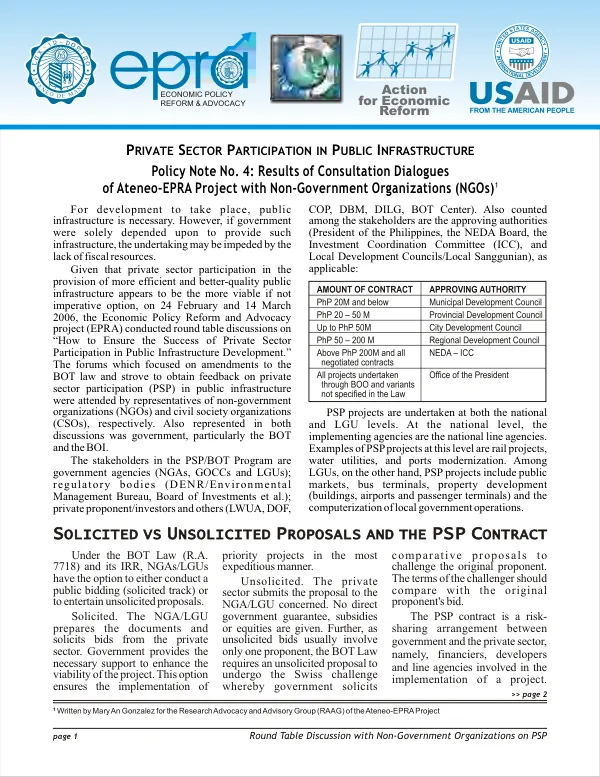
However, the lack of fiscal resources can impede government's ability to provide such infrastructure. Private sector participation in public infrastructure development appears to be a more viable option, as it can provide more efficient and better-quality infrastructure. On February 24 and March 14, 2006, the Economic Policy Reform and Advocacy project (EPRA) conducted round table discussions on "How to Ensure the Success of Private Sector Participation in Public Infrastructure Development." The forums focused on amendments to the BOT law and obtained feedback on private sector participation in public infrastructure from representatives of non-government organizations (NGOs) and civil society organizations (CSOs). The stakeholders in the PSP/BOT Program include government agencies, regulatory bodies, private proponents/investors, and approving authorities. PSP projects are undertaken at both the national and local government unit (LGU) levels. At the national level, implementing agencies are national line agencies, while at the LGU level, PSP projects include public markets, bus terminals, property development, and computerization of local government operations. Under the BOT Law (R.A. 7718) and its implementing rules and regulations (IRR), NGAs/LGUs have the option to either conduct a public bidding (solicited track) or entertain unsolicited proposals. Solicited proposals involve the NGA/LGU preparing documents and soliciting bids from the private sector, while unsolicited proposals involve the private sector submitting a proposal to the NGA/LGU concerned. The PSP contract is a risk-sharing arrangement between government and the private sector, involving financiers, developers, and line agencies involved in the implementation of a project. Contingent subsidies may become contingent liabilities in the course of a 20- to 25-year concession period, while contingent liabilities are risks assumed by government without incurring upfront fiscal cost. During the discussions, a number of perceived deterrents to PSP in public infrastructure emerged, including government-related issues such as bureaucratic inertia, lack of transparency, and political intervention. Finance-related issues include high costs of submitting a proposal, projects' seeming inability to make money per specifications given, and high costs of financing. Incentives-related issues include incentives for solicited projects, transparency, and accountability. The citizenry also raised concerns about profits, nationalist provisions, and the role of citizens in policy formulation. Matters of procedure were also discussed, including the need for the BOT Law to provide for the mechanics for the final stage of a project, accessibility of information to everyone during the project's entire cycle, and strong regulation on the government side. The IRR was also a topic of discussion, including the need for specific hurdle rates and the avoidance of implementing rules and regulations after five years. Observations were made regarding the lack of mention in the bill regarding institutionalizing the budgeting and report format of monitoring.
![Evaluation of the US-Asia environmental partnership [US-AEP]](https://covers.devme.ai/gen/5422.webp)