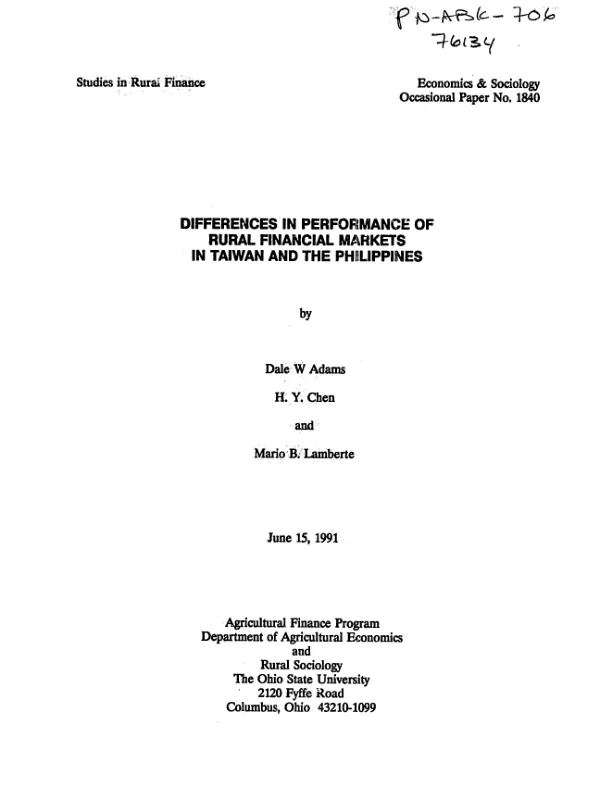
OHIO STATE UNIVERSITY. DEPT. OF AGRICULTURAL ECONOMICS AND RURAL SOCIOLOGY. AGRICULTURAL FINANCE PROGRAM
Political economy of rural loan recovery : evidence from Bangladesh
The problem of recovering rural loans in developing countries is frequently analyzed from the perspective of borrowers or financial institutions.
Khalily, M. A. Baqui; Meyer, Richard L. · 1992
Sign in to readA free account is required to download.
Abstract
Frequently overlooked is the fact that borrowers are often discouraged to repay and/or institutions are not aggressive in loan recovery, because governments intervene in rural financial markets to increase the re-election prospects of incumbent officeholders. Such political intervention may undermine the effectiveness of measures to improve loan allocation and recovery, such as increasing real interest rates. A failure to address this political dimension in loan recovery analysis may lead to incorrect policy prescriptions. This paper provides an empirical analysis of how political interventions affected rural loan recovery in Bangladesh in the period 1980- 1989. The results indicate that the negative effect of political intervention in loan allocation and recovery outweighs the effect of positive real interest rates. The government in Bangladesh intervenes in rural loan allocation and recovery both formally, through policies such as interest exemptions, credit committees, and interest rates, and informally, through local elected officials and sociopolitical leaders. The intensity of informal intervention increases during an election period. Five variables -- inflation rate, election years, interest exemption years, credit committee years, and bank type -- were included in the model used to explain loan recovery. The empirical results showed that elections, inflation rates, credit committees, and bank type affect rural loan recovery negatively, while interest exemptions affect it positively. (Author abstract, modified)