MACEDONIAN MINISTRY OF AGRICULTURE, FORESTRY AND WATER ECONOMY
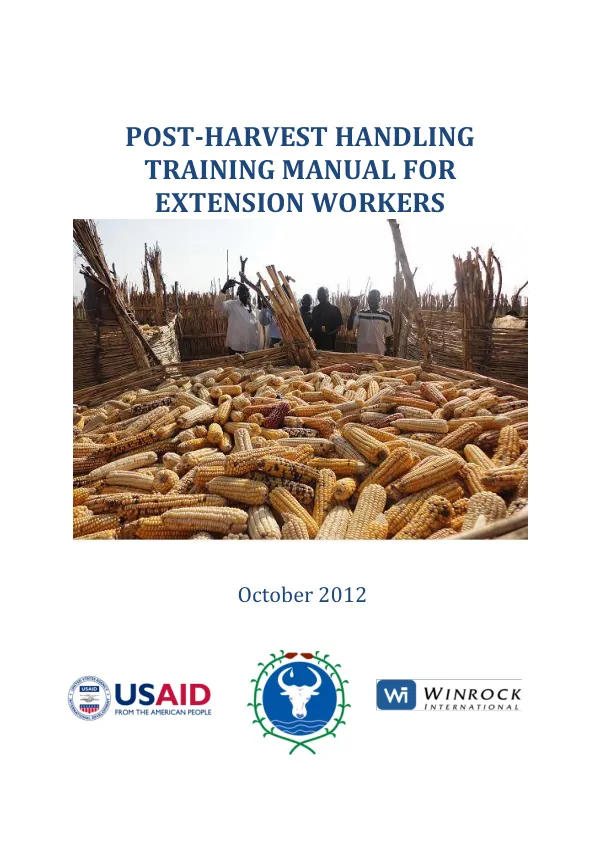
Post-Harvest Handling Training Manual for Extension Workers
The Post-Harvest Handling Training Manual for Extension Workers was produced with the support of the American people through the United States Agency for International Development (USAID).
2012 · 22 pages
Sign in to readA free account is required to download.
Abstract
The manual was prepared by Winrock International in collaboration with the Warrap State Ministry of Agriculture and Forestry, under the Cooperative Agreement No. 650-A-00-09-00003-00, Building Responsibility for Delivery of Government Services (BRIDGE) Program. The manual is intended to assist Warrap agricultural extension workers in planning and carrying out post-harvest management training sessions for farmers at the county, payam, and boma levels. The goal of the training is to help farmers acquire knowledge and experience in improved crop handling and storage techniques, which will enable them to better protect their harvested crops from damage by exposure to the elements, diseases, insect pests, and rodents. The manual focuses on the process of harvesting, post-harvest handling practices, and storage facilities. It covers topics such as drying, threshing/shelling, causes and methods of loss prevention and control, insects, secondary pests, moulds, termites, rodents, birds, and storage practices. The manual also includes information on traditional and improved storage facilities, as well as storage practices. The manual is supplemental to two previously completed technical guides, the Animal Traction and Crop Production training manuals developed collaboratively by the Ministry of Agriculture and Forestry, BRIDGE, and the Yei Agricultural Training Center. The use of improved crop handling and storage techniques by farmers will help them to better protect their harvested crops and increase the amount of food available for local consumption, enabling farmers to maximize gains through the sale of additional surplus harvests at market. The manual is intended to be used in participatory and practical training exercises with agricultural extension workers, who will conduct follow-up visits to growers to ensure they are actively adopting the improved/best practices in their fields. The manual is hoped to be useful and will be further adapted to include lessons emerging from field experiences to enhance the work already being performed by state extension service officials in support of South Sudanese farmers. Agricultural extension workers are advised to thoroughly understand the lessons described in the manual before undertaking training exercises for targeted farmers. In the event of questions or concerns about the content of the manual, trainers are strongly encouraged to contact BRIDGE agricultural specialists for assistance. The lessons described within the manual are prepared so that trainees can easily learn from discussions, questions, and answers in the process of training.