UNITED NATIONS
Postpartum Insertion of IUCD: A Safe and Effective Contraceptive Option
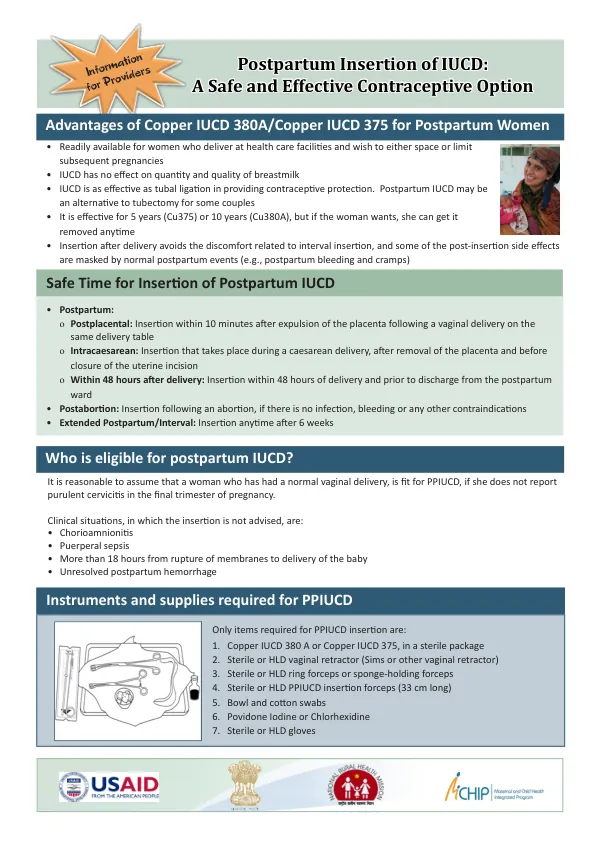
Postpartum insertion of the intrauterine contraceptive device (IUCD) is a safe and effective contraceptive option for women who deliver at healthcare facilities and wish to space or limit subsequent pregnancies.
2014 · 2 pages
Sign in to readA free account is required to download.
Abstract
The IUCD has no effect on the quantity and quality of breastmilk, making it an ideal choice for breastfeeding women. It is as effective as tubal ligation in providing contraceptive protection, and postpartum IUCD may be an alternative to tubectomy for some couples. The IUCD is effective for 5 years (Cu375) or 10 years (Cu380A), but it can be removed anytime if the woman desires. Insertion after delivery avoids the discomfort related to interval insertion, and some of the post-insertion side effects are masked by normal postpartum events. Postpartum insertion can be done within 10 minutes after expulsion of the placenta following a vaginal delivery, during a caesarean delivery, or within 48 hours after delivery. The advantages of copper IUCD 380A/Copper IUCD 375 for postpartum women include high client motivation and assurance that the woman is not pregnant. Good client selection reduces the risk of infection, and infection prevention practices should be followed during insertion and for processing instruments. No prophylactic antibiotics are needed, and expulsion can be minimized by inserting the IUCD within 10 minutes after delivery of the placenta, placing it sufficiently high at the uterine fundus, and using a provider specially trained on PPIUCD insertion technique. Clinical situations in which the insertion is not advised include chorioamnionitis, puerperal sepsis, more than 18 hours from rupture of membranes to delivery of the baby, and unresolved postpartum hemorrhage. The instruments and supplies required for PPIUCD insertion include a copper IUCD 380 A or Copper IUCD 375, a sterile or HLD vaginal retractor, sterile or HLD ring forceps or sponge-holding forceps, sterile or HLD PPIUCD insertion forceps, a bowl and cotton swabs, povidone iodine or chlorhexidine, and sterile or HLD gloves. Studies have shown that postpartum IUCD insertion is generally safe and effective, with expulsion rates appearing to be slightly higher than with interval IUCD. The post-partum IUCD insertion is popular in countries as diverse as China, Mexico, and Egypt, supporting the feasibility of this approach in other countries. Early follow-up may be important in identifying spontaneous expulsion.